Choosing the wrong link-building provider can damage more than a campaign. It can hurt your agency’s trust, reporting, margins, and client retention. If you want to choose white label link building partner support that actually works, you need to look beyond DR numbers and cheap link packages.
In my experience, the best partner is not the one with the biggest list of websites. It is the one that gives you transparency, quality control, a clear process, clean white-label reporting, and low-risk delivery. This guide will show you how to choose white label link building partner options with a practical checklist your agency can use before signing anything.
What to Look for in a White-Label Link-Building Partner
What to Look for in a White-Label Link-Building Partner
A good white-label link-building partner should protect your agency, not create more work for you. Before you compare prices, check whether the provider gives you visibility, control, and reliable delivery.
When agencies try to choose white label link building partner options too quickly, they often focus only on DR, price, or turnaround time. Those things matter, but they do not tell the full story. The real question is simple: can this provider safely represent your agency behind the scenes?
Why This Is a Provider-Selection Decision, Not a General SEO Guide
This decision is not about learning what link building is. It is about choosing who you trust with your client campaigns.
A weak provider can create low-quality links, poor reports, missed deadlines, and awkward client conversations. A strong provider makes fulfillment smoother, keeps your agency in control, and gives you proof before anything goes live.
That is why I look at the provider’s process before I look at their packages.
The Five Areas Every Agency Should Check
When I evaluate a white-label SEO partner, I focus on five areas:
- Transparency: Can I see the websites, metrics, and process?
- Quality: Are the links relevant, editorial, and placed on real sites?
- Process: Is there a clear approval and delivery workflow?
- Reporting: Can I send the report to my client under my brand?
- Risk: Are they avoiding PBNs, spam sites, and unsafe shortcuts?
These five checks give you a simple framework. They also help you compare one outsourced link building company against another without getting distracted by sales language.
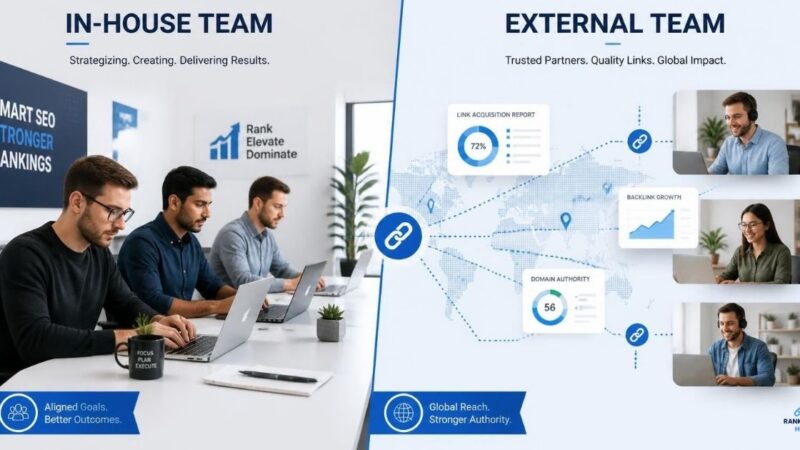
When to Consider an Agency Fulfillment Partner Instead of Hiring In-House
An agency fulfillment partner makes sense when your team needs link-building delivery but does not want to manage outreach, content, publisher communication, and reporting internally.
In-house hiring gives you more direct control, but it also adds salaries, tools, training, and management time. White-label support is usually better when you need flexible capacity, faster delivery, and client-ready reporting without building a full outreach team.
The key is not to outsource blindly. The goal is to find a partner who follows your standards and helps your agency deliver with confidence.
Transparency: Can You See What Happens Before Publishing?
Transparency is the first thing I check before trusting any white-label link-building partner. If a provider cannot show how links are sourced, reviewed, and approved, your agency is taking on hidden risk.
A reliable partner should not ask you to “just trust the process.” They should be able to explain the process clearly before you place an order.
Do They Explain Their Link-Building Method Clearly?
Ask how they find publishers, how they contact them, and how they decide which sites are safe for clients.
You do not need every internal detail. But you should understand whether they use manual outreach, existing publisher relationships, or a mixed process.
If the answer sounds vague, that is a warning sign.
Do They Show Publisher Examples Before You Pay?
A good provider should be able to show sample placements or example publisher quality.
You are not only checking DR. You are checking relevance, traffic, site quality, content standards, and whether the link looks natural inside the article.
This helps you judge the provider before your client’s brand is involved.
Can Your Agency Approve Websites Before Links Go Live?
Approval control is important for agencies. Your client may have niche rules, brand safety concerns, or sites they do not want to appear on.
The right partner should share publisher options before publishing. This gives your agency the final say and keeps the client relationship protected.
At Rankora HQ, nothing should go live without approval. That is how white-label fulfillment should work.
Red Flag: Vague Promises With No Proof
Be careful with phrases like “premium links,” “high-authority placements,” or “exclusive sites” when there is no data behind them.
A real provider can show metrics, examples, and a clear workflow. A weak provider hides behind big words.
If they cannot explain what you are buying, your agency should not sell it to clients.
Quality: Are the Links Actually Worth Building?
Link quality matters more than link volume. A white-label partner should not only deliver backlinks. They should deliver placements your agency can confidently show to clients.
When you review any provider, look at the website, the article, the anchor text, and the link context together. A strong link should make sense for the client’s niche and not look forced.
Why Relevance Matters More Than DR Alone
DR is useful, but it is not enough. A high-DR site with no topical relevance can still be a weak placement.
For example, a SaaS client does not need random links from lifestyle blogs unless the topic connects naturally. Relevance makes the link safer, more useful, and easier to justify in client reporting.
Check Organic Traffic, Indexing, and Editorial Standards
Before approving a site, check whether it gets real organic traffic and has indexed pages.
Also review the content quality. If the site publishes thin, spammy, or unrelated articles every day, avoid it. Good publishers have real editorial standards and do not accept every topic.
Review Anchor Text Control and Placement Context
Anchor text should look natural. Over-optimized anchors can create risk, especially when repeated across many placements.
A good provider should help you balance branded, partial-match, and natural anchors. The link should also appear inside useful content, not randomly added into a weak paragraph.
Simple Link Building Provider Checklist for Quality Review
Use this quick checklist before approving a placement:
- Is the site relevant to the client’s niche?
- Does it have real organic traffic?
- Are pages indexed in Google?
- Is the content quality acceptable?
- Does the link placement look natural?
- Is the anchor text safe?
- Would you feel comfortable showing this link to the client?
If the answer is no to more than one of these, the placement is probably not worth approving.
Process: Can They Deliver Consistently?
A good process makes white-label link building easier to manage. Your partner should have a clear workflow from campaign intake to final report.
If the process is messy before the first order, delivery will likely become harder when you scale.
How They Collect Campaign Requirements
The provider should ask for clear campaign details before starting.
This includes the client niche, target pages, anchor text preferences, competitor examples, site restrictions, and link goals.
If they start pitching links without understanding the client, they are not building a strategy. They are just selling placements.
How They Find and Vet Publishers
Ask how publishers are selected before they are sent for approval.
A reliable provider should check relevance, organic traffic, indexing, content quality, spam signals, and editorial fit.
This step matters because your agency should not waste time reviewing weak websites that should have been filtered earlier.
How Approval, Content, Publishing, and Revisions Work
Your agency should know exactly what happens at each stage.
The provider should explain:
- When publisher options are shared
- Who approves the sites
- Who writes the content
- How revisions are handled
- When the live link and report are delivered
This keeps the campaign organized and avoids confusion with clients.
How to Test an Outsourced Link Building Company Before Scaling
Start with a small test campaign before sending a full client load.
I usually recommend testing with a few placements first. Review their communication, site quality, turnaround time, reporting, and how they handle feedback.
If they perform well on a small order, then you can consider increasing volume with less risk.
Reporting: Can You Show Clients Clear Proof?
Reporting is where your agency proves the value of the work. A good white-label link-building partner should give you clean, client-ready reports that are easy to understand and simple to rebrand.
Weak reporting creates confusion. Strong reporting helps your agency look organized, transparent, and professional.
What a Proper White-Label Report Should Include
A proper report should include the live URL, target URL, anchor text, publisher name, key metrics, and publication date.
It should also show whether the content is live, indexed, and placed correctly. Your agency should not have to chase basic delivery details after the link goes live.
Why Live URLs, Metrics, Anchors, and Publisher Details Matter
Clients want proof, not vague updates.
Live URLs show the work is complete. Metrics help explain the value of the placement. Anchor details show the strategy behind the link. Publisher details help the client understand where their brand is being mentioned.
This makes the final report easier to defend in client calls.
How Reporting Protects Your Agency’s Client Relationship
Good reporting reduces back-and-forth. It gives your client clear evidence and keeps your agency in control of the conversation.
If a provider sends messy screenshots or incomplete spreadsheets, your team has to clean everything before sharing it. That wastes time and weakens trust.
A reliable partner should provide a clean white-label SEO reporting service that your agency can send under its own brand.
Risk: What Should Make You Walk Away?
Risk is the biggest reason agencies should be careful when choosing a white-label link-building partner. A cheap provider can look attractive at first, but one bad link strategy can damage client trust fast.
If a provider avoids clear answers, hides site details, or promises results they cannot control, treat it as a warning sign.
Guaranteed Rankings
No link-building provider can honestly guarantee rankings.
Backlinks can support SEO growth, but rankings depend on many things, including content quality, technical SEO, competition, and Google updates.
If a provider promises fixed rankings, they are overselling.
Cheap Bulk Links
Very cheap bulk links usually come with hidden problems.
They may come from low-quality blogs, link farms, irrelevant sites, or publishers with no real traffic. These links are hard to defend when a client asks for proof.
A good partner focuses on quality and relevance, not just volume.
PBNs, Link Farms, or Recycled Publisher Lists
Avoid providers that use PBNs, link farms, or the same publisher list for every client.
These footprints can create risk, especially when multiple clients get links from the same weak network.
Ask directly how they source publishers. A serious provider should answer clearly.
No Approval Process
If your agency cannot approve websites before publishing, you lose control.
This is risky because the provider may place links on sites your client would reject. Approval should happen before content goes live, not after the report is delivered.
No Replacement Policy
Links can be removed, pages can change, and publishers can update content.
A reliable partner should have a clear replacement policy. If they do not explain what happens after a link is lost, your agency may be left handling the problem alone.
Poor Communication Before the First Order
Early communication shows how the provider will behave later.
If they reply slowly, avoid details, or send unclear answers before payment, do not expect better service after the order starts.
Good communication is part of safe fulfillment.
Backlink Vendor Evaluation Scorecard
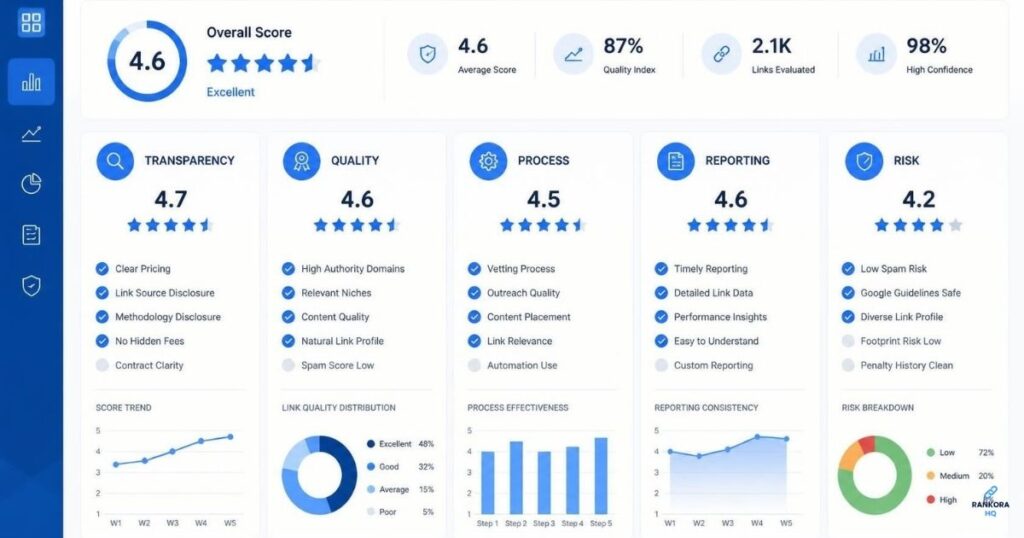
A scorecard helps your agency compare providers without relying on sales calls alone. Use it to rate each white-label link-building partner across the five areas that matter most.
Score each area from 1 to 5. A provider with weak scores in transparency, quality, or risk should not be trusted with client campaigns.
Transparency Score
Rate how clearly the provider explains their process.
Check whether they show sample placements, publisher metrics, outreach methods, and approval steps before you pay.
Low score: vague promises.
High score: clear proof and open communication.
Quality Score
Rate the quality of the links they offer.
Look at relevance, organic traffic, indexing, content standards, anchor text safety, and placement context.
A good backlink vendor evaluation should focus on real link value, not only DR.
Process Score
Rate how organized their delivery system is.
A strong provider should have a clear workflow for intake, site selection, approval, content, publishing, revisions, and reporting.
If the process feels unclear, scaling will be difficult.
Reporting Score
Rate whether the report is client-ready.
The report should include live URLs, target pages, anchors, publisher details, metrics, and publication dates.
It should also be easy to send under your agency brand.
Risk Score
Rate how safely the provider builds links.
Check for PBN use, link farms, bulk link packages, no approval process, no replacement policy, or guaranteed ranking claims.
A high-risk provider may create problems your agency has to fix later.
How to Compare Two White Label SEO Partner Options Side by Side
Put both providers in a simple table and score each category.
| Evaluation Area | Provider A | Provider B |
| Transparency | 1–5 | 1–5 |
| Quality | 1–5 | 1–5 |
| Process | 1–5 | 1–5 |
| Reporting | 1–5 | 1–5 |
| Risk Control | 1–5 | 1–5 |
| Total Score | /25 | /25 |
Do not choose only by total score. If one provider scores low on quality or risk control, avoid them even if their price is better.
Questions to Ask Before Choosing a Provider
Can I Approve Every Publisher Before Publishing?
Your agency should have final approval before any link goes live.
This protects your client’s brand and prevents placements on sites that do not match the niche, quality level, or campaign goals.
What Metrics Do You Check Before Recommending a Site?
Ask which metrics they review before sending publisher options.
A reliable provider should check relevance, organic traffic, indexing, content quality, spam signals, and editorial standards.
DR alone is not enough.
Do You Write the Content or Only Place Links?
Some providers only sell placements. Others handle content writing, editing, and publishing.
For agencies, full support is often easier because it keeps the campaign in one workflow. Just make sure the content quality matches your client’s standards.
What Happens If a Link Is Removed?
Links can be removed after publishing. That is why you need to ask about replacement terms before ordering.
A serious white label SEO partner should explain how long the link is protected and what happens if the publisher removes it.
Can Reports Be Delivered Under My Agency Brand?
White-label reporting matters because your client should see your agency as the service provider.
Ask whether reports can be delivered without the vendor’s branding. The report should be clean, professional, and ready to share.
Have You Handled My Client’s Niche Before?
Niche experience matters, especially for legal, finance, SaaS, health, and technical industries.
A provider does not need to know every niche perfectly. But they should understand how to find relevant publishers and avoid risky placements in sensitive markets.
Frequently Asked Questions
How do I choose a white label link building partner?
Choose a partner by checking transparency, link quality, process, reporting, and risk control. Do not decide only by price or DR.
What should I include in a link building provider checklist?
Your checklist should include niche relevance, organic traffic, indexing, anchor text safety, approval process, reporting quality, and replacement policy.
How do I know if a backlink vendor is safe?
A safe vendor shows real publisher details, avoids PBNs, explains the process clearly, and lets your agency approve links before publishing.
What makes a good white label SEO partner?
A good white label SEO partner works quietly behind your agency, protects your client relationship, and delivers clean reports under your brand.
Should I test an outsourced link building company first?
Yes. Start with a small test order to review communication, publisher quality, turnaround time, and reporting before scaling.
What red flags should agencies avoid?
Avoid guaranteed rankings, very cheap bulk links, hidden publisher lists, no approval process, weak reports, and unclear replacement terms.
Is DR enough to judge link quality?
No. DR is only one metric. You should also check relevance, organic traffic, indexing, content quality, and placement context.
Can white-label link building be safe for client campaigns?
Yes, if the partner uses editorial placements, clear approval steps, relevant publishers, and transparent reporting.
Conclusion and Author Bio
Conclusion
Choosing the right white-label partner is not about finding the cheapest links or the fastest delivery. It is about finding a provider your agency can trust with client work, brand safety, and long-term results.
Before you choose white label link building partner support, check five things: transparency, quality, process, reporting, and risk control. If a provider is clear in these areas, start with a small test campaign before scaling. If you want editorial placements with approval before publishing, Rankora HQ can help your agency deliver link building under your own brand.
Author Bio
Author: Muhammad Awais
Title: Founder, Rankora HQ
Muhammad Awais is the founder of Rankora HQ, a white-label editorial content placement service based in Salalah, Oman. He helps SEO agencies and brands build topical authority through high-quality publishing partnerships on DR 40-90 editorial sites.
LinkedIn: linkedin.com/in/muhammad-awais-seo-outreach