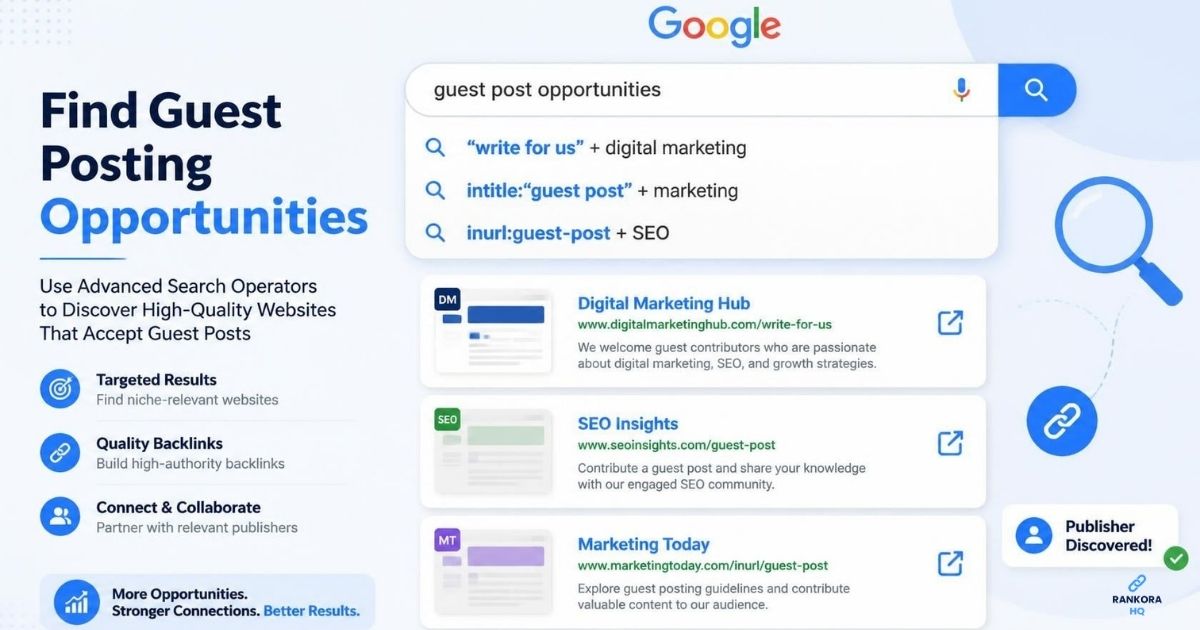
Finding guest posting sites manually can waste hours if you only search broad terms like “blogs in my niche.” Guest post search operators help you use Google more precisely, so you can uncover contributor pages, write-for-us pages, and relevant publishing opportunities faster.
In my experience, guest post search operators work best when they are used with clear niche modifiers, not random keywords. This guide will show you practical operator patterns, examples like intitle: and inurl:, and the limits of using guest post search operators for publisher discovery.
What Are Guest Post Search Operators?
Guest post search operators are special Google search commands that help you find websites that accept guest posts, contributor articles, or outside submissions. Instead of searching broad phrases, you use focused patterns like “write for us” + niche or intitle:”guest post” to narrow the results.
For example, if I want to find marketing blogs that accept contributors, I would not just search “marketing blogs.” I would search something like:
“write for us” + marketing
That tells Google to show pages that include the exact phrase “write for us” and are connected to the marketing niche.
Simple Definition for Outreach Teams
For outreach teams, guest post search operators are a discovery tool. They help you find potential publisher pages faster by filtering Google results around specific words, titles, URLs, or domains.
This is useful when you need to build a raw list of sites before checking quality, traffic, relevance, or editorial standards.
How Google Operators Narrow Guest Post Discovery
Google operators narrow results by telling Google what to include or exclude.
For example:
intitle:”write for us” + SaaS
This looks for pages with “write for us” in the title and SaaS as the niche modifier.
Another example:
inurl:”guest-post” + finance
This helps find URLs that include “guest-post” and relate to finance.
These searches are not perfect, but they remove a lot of noise compared to normal keyword searches.
What This Method Can and Cannot Find
This method can find public contributor pages, submission guidelines, author pages, and guest post footprints.
But it cannot tell you if a site is high quality. It also cannot confirm if the publisher still accepts guest posts.
That part still needs manual review. In my experience, operators are best for finding possible opportunities. They are not a replacement for checking relevance, traffic, editorial quality, and approval rules.
Why Use Google Operators for Guest Posting?
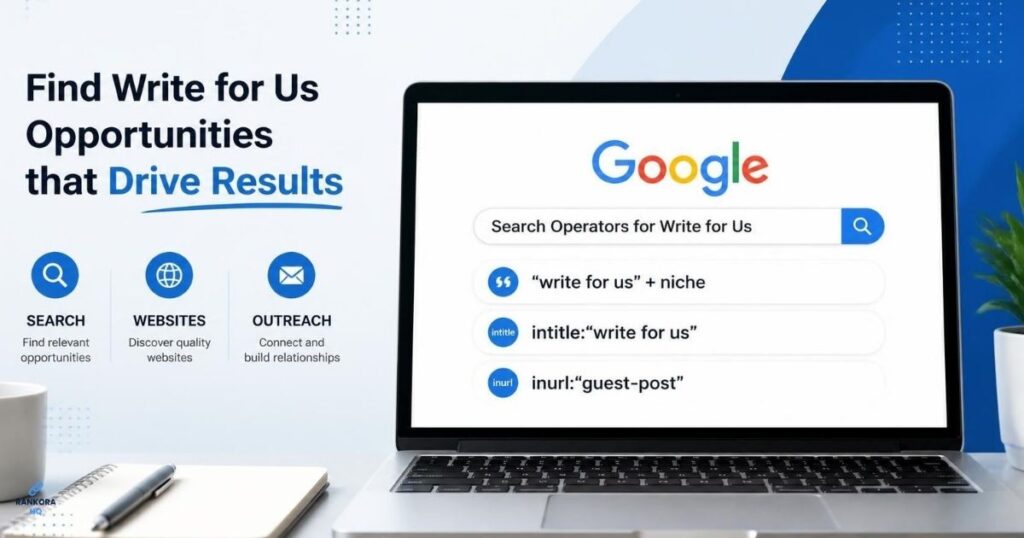
Google operators help you find guest posting opportunities with more control than normal search. Instead of scrolling through broad results, you can search for pages that already show signs of accepting outside content.
Faster Niche-Specific Publisher Discovery
A normal search like “business blogs” is too broad. It can show news sites, personal blogs, directories, and pages that have nothing to do with guest posting.
A focused search works better:
“write for us” + business
This gives you a cleaner starting point. You can replace “business” with your niche, such as SaaS, finance, health, real estate, or marketing.
Better Control Than Random Prospecting Lists
Many public guest post lists are outdated. Some sites stop accepting submissions, change their guidelines, or become low-quality over time.
Google operators let you build your own list from live search results. You can test different phrases, compare pages, and decide which sites are worth reviewing.
This does not make every result good. It only gives you more control over what you find.
Basic Guest Post Search Operators to Start With
The easiest way to use Google for guest post discovery is to start with simple phrase-based searches. These operators help you find pages where publishers mention guest posts, contributor content, or article submissions.
I usually begin with broad operator patterns first. Then I narrow them with niche words once I see what type of results Google is showing.
“guest post” + niche
This is one of the simplest searches to start with.
Example:
“guest post” + marketing
This can help you find pages that mention guest posts in your niche. It may show published guest articles, guest post guidelines, or blogs that have accepted outside contributors before.
“submit a guest post” + niche
This search is more direct because it looks for pages where the site clearly invites submissions.
Example:
“submit a guest post” + SaaS
This works well when you want to find submission pages instead of general blog posts.
“guest article” + niche
Some publishers do not use the phrase “guest post.” They may call it a guest article, contributor article, or expert contribution.
Example:
“guest article” + finance
This can uncover sites that may not appear when you only search for “guest post.”
“contribute” + niche
This operator is useful for finding contributor pages.
Example:
“contribute” + health
The results may include pages like “contribute to our blog,” “become a contributor,” or “submit your article.” You still need to review each site because “contribute” can also bring up donation pages, nonprofit pages, or unrelated results.
“Write for Us” Search Operators That Still Work
“Write for us” search operators help you find pages where websites openly invite contributors. These pages are usually easier to identify because the publisher has already created submission guidelines.
I still use these searches in the early discovery stage. The key is to combine them with niche terms so the results stay relevant.
“write for us” + niche
This is the most common operator for finding guest post pages.
Example:
“write for us” + real estate
It helps you find websites that mention “write for us” and are connected to your target niche. The results may include contributor pages, blog guidelines, or editorial submission pages.
“write for us” + industry
Sometimes an industry term works better than a narrow niche.
Example:
“write for us” + digital marketing
This can bring up broader sites that cover several related topics. It is useful when your client’s niche overlaps with more than one category.
“become a contributor” + niche
Not every site uses “write for us.” Some use phrases like “become a contributor.”
Example:
“become a contributor” + technology
This operator often finds sites with contributor programs, expert columns, or industry blog submissions.
“submit an article” + niche
This search is useful when you want pages focused on article submissions.
Example:
“submit an article” + finance
It can uncover sites that accept outside content but do not label it as guest posting. Review each result carefully because some pages may be academic, news-based, or unrelated to SEO outreach.
Advanced Google Operators for Guest Posting
Advanced Google operators help you find more specific guest posting pages by searching page titles, URLs, domains, and exact phrases. These searches are useful when basic operators start showing repeated or weak results.
I use them when I want tighter control over what Google returns.
Using intitle:”write for us” + niche
The intitle: operator tells Google to find pages where a phrase appears in the page title.
Example:
intitle:”write for us” + SaaS
This can help you find pages where “write for us” is a main topic, not just a random phrase in the content.
You can also test:
intitle:”guest post” + marketing
This works well for finding pages that are clearly built around guest posting or contributor guidelines.
Using inurl:”guest-post” + niche
The inurl: operator looks for words inside the page URL.
Example:
inurl:”guest-post” + finance
This may find pages with URLs like:
/guest-post-guidelines/
/submit-guest-post/
/guest-posts/
This is useful because many sites use clear URL structures for contributor pages.
Using site:.com “contribute” + niche
The site: operator helps you search within a specific domain type or website.
Example:
site:.com “contribute” + health
This tells Google to show .com pages that mention “contribute” and relate to health.
You can also use it for country-level domains:
site:.co.uk “write for us” + business
This is helpful when you want publisher opportunities in a specific market.
Combining Quotes, intitle, inurl, and Site Filters
The best results often come from combining operators.
Example:
intitle:”write for us” inurl:”guest-post” + technology
This search looks for pages with “write for us” in the title, “guest-post” in the URL, and technology as the niche.
But do not make every search too narrow. If Google shows very few results, remove one filter and try again.
How to Combine Operators With Niche Modifiers
The best results usually come when you combine search operators with clear niche modifiers. A modifier tells Google what industry, audience, or topic you want the guest post opportunity to match.
For example, “write for us” alone is too broad. But “write for us” + SaaS marketing gives Google a much clearer direction.
Add Industry Terms for Tighter Results
Start by adding the main industry after the operator.
Examples:
“write for us” + real estate
“guest post” + cybersecurity
intitle:”write for us” + healthcare
This helps you avoid random sites that accept guest posts but have no topical match with your client.
Add Audience Terms
Audience modifiers can make your results more relevant.
Examples:
“submit an article” + startup founders
“become a contributor” + small business owners
inurl:”guest-post” + SaaS companies
This works well when the niche is broad, but the client wants to reach a specific reader group.
Add Content Type Terms
You can also add content type modifiers to find pages that match your outreach angle.
Examples:
“write for us” + marketing blog
“contribute” + finance guide
“submit an article” + business resources
These searches help you find blogs, resource hubs, and educational sites instead of unrelated company pages.
Example Operator Combinations for Real Searches
Here are a few practical combinations:
intitle:”write for us” + B2B SaaS
inurl:”guest-post” + personal finance
“submit a guest post” + digital marketing
site:.com “become a contributor” + health
In my experience, the best approach is to test 5–10 variations per niche. Some operators will show weak results, but a few will usually uncover useful publisher pages.
Finding Competitor Guest Post Footprints
Competitor guest post footprints help you find websites where similar brands, authors, or agencies have already published outside content. This is useful because those sites may be open to relevant contributor pitches.
The goal here is simple discovery. You are not doing a full backlink audit. You are only using Google to spot publishing patterns.
Search Competitor Brand Names With Guest Post Terms
Start by combining a competitor’s brand name with guest post phrases.
Examples:
“competitor brand” + “guest post”
“competitor brand” + “write for us”
“competitor brand” + “contributor”
This can help you find articles, author bios, interviews, or contributor pages connected to that competitor.
Use Author Names to Find Repeated Publisher Patterns
If a competitor has a known founder, marketer, or content author, search their name with guest post terms.
Example:
“author name” + “guest post”
“author name” + “contributor”
“author name” + “published on”
This may show websites where the same person has contributed content across multiple blogs.
Look for Recurring Contributor Bios
Guest posts often include short author bios. These bios may mention the author’s company, role, website, or area of expertise.
Search patterns like:
“author name” + “is the founder of”
“brand name” + “author bio”
“brand name” + “contributed to”
These searches can reveal publisher pages that do not clearly advertise guest posting but still accept outside experts.
Using Negative Operators to Remove Bad Results
Negative operators help you remove search results that are not useful for guest post discovery. They are especially helpful when Google starts showing jobs, forums, PDFs, directories, or unrelated pages.
The minus sign – tells Google to exclude a word from the results.
Remove Jobs, Careers, and Hiring Pages
Some searches bring up writing jobs instead of guest posting pages.
Example:
“write for us” + marketing -jobs -career -hiring
This helps remove pages about employment, freelance writing jobs, or content writer openings. It keeps the search closer to contributor and submission pages.
Remove PDFs, Forums, and Social Threads
Google may also show PDFs, forum discussions, or social posts that are not useful for outreach.
Example:
“submit a guest post” + finance -pdf -forum -reddit
This can clean up the results when you only want live website pages.
Use this carefully. Sometimes Reddit or forums can help you discover publisher names, but they are usually not direct guest post targets.
Filter Out Low-Quality Directories
Some guest post searches show long directory lists instead of real publisher pages.
Example:
“guest post” + health -“guest post sites” -“guest posting sites list”
This helps reduce listicle-style results that may be outdated, overused, or filled with low-quality sites.
Avoid Over-Filtering Good Publishers
Negative operators are useful, but too many filters can hide good results.
If your search becomes too narrow, Google may show very few pages. Start with one or two exclusions, review the results, then adjust.
In my experience, the best approach is simple: remove obvious noise first, then manually review the sites that remain.
How to Organize and Qualify the Sites You Find
After using search operators, organize every useful result in a simple sheet. This keeps your discovery process clean and helps you avoid reviewing the same site again.
At this stage, you are not approving sites yet. You are only saving potential publishers for manual review.
Save the Main Details First
Start with the basic information.
Add columns for:
- Website URL
- Submission page URL
- Niche
- Search operator used
- Contact page
- Notes
This helps you remember how you found the site and why it looked relevant.
Limitations of Guest Post Search Operators
Guest post search operators are useful for discovery, but they do not guarantee quality. They only help you find possible websites, not approve them for outreach or publishing.
This is where many people make mistakes. They find a “write for us” page and assume the site is good. That is not enough.
Many Good Publishers Do Not Advertise Guest Posts
Some strong editorial sites accept expert contributions but do not have a public “write for us” page.
That means Google operators may miss them.
You may need other discovery methods later, but this article is focused only on operator-based searching.
Some “Write for Us” Pages Attract Low-Quality Submissions
A public “write for us” page can attract spammy pitches. Because of that, some sites with these pages may have weak editorial standards.
Always review the site before adding it to your final list.
Check the content quality, outbound links, publishing frequency, and whether the topics look natural.
Google Results Can Be Repetitive or Outdated
Google may show the same sites again and again with different operator searches.
Some pages may also be old, inactive, or no longer accepting submissions.
That is why I always mark the search operator used and remove duplicates from the sheet.
Operators Find Opportunities, But Review Decides Quality
Search operators help you find possible guest posting opportunities. They do not replace manual review.
Before outreach, check:
- Niche relevance
- Site activity
- Content quality
- Organic traffic signs
- Editorial standards
- Client fit
In my experience, the best results come from using operators for discovery and human judgment for approval.
FAQs About Guest Post Search Operators
What are guest post search operators?
Guest post search operators are Google search commands that help you find websites accepting guest posts, contributor articles, or outside submissions.
What is the best search operator for guest posting?
A good starting operator is “write for us” + niche because it helps find pages where websites openly invite contributors.
How do I use write for us search operators?
Use the phrase with your niche, such as “write for us” + SaaS or “write for us” + real estate, then review each result manually.
Does intitle:”guest post” still work?
Yes, it can still work, but results may include outdated or low-quality pages. Always check the site before adding it to your outreach list.
How does inurl:”guest-post” help?
The inurl: operator finds pages where “guest-post” appears in the URL, which can reveal guest post guidelines or published contributor pages.
Can Google operators find high-quality guest posting sites?
They can help you find possible sites, but they cannot prove quality. You still need to check relevance, traffic, content standards, and editorial fit.
Are guest post search operators enough for link building?
No. They are useful for discovery, but proper guest posting also needs manual review, outreach, content planning, and publisher approval.
What should I do after finding a guest post opportunity?
Save the site in a review sheet, check its niche relevance, read the guidelines, and confirm whether it matches your campaign goals.
Conclusion
Guest post search operators are a practical way to find relevant publisher opportunities through Google. They help you search beyond broad terms and uncover pages like “write for us,” contributor guidelines, and guest post submission pages.
But operators are only the first step. A site still needs manual review before outreach. Check its niche relevance, content quality, traffic signals, and editorial standards before adding it to your final list.
If you want a cleaner process, start with simple searches, test niche modifiers, remove bad results with negative operators, and organize every useful site in a review sheet. That is how I use guest post search operators to turn raw Google results into better publisher discovery.
Author Bio
Author: Muhammad Awais
Title: Founder, Rankora HQ
Muhammad Awais is the founder of Rankora HQ, a white-label editorial content placement service based in Salalah, Oman. He helps SEO agencies and brands build topical authority through high-quality publishing partnerships on DR 40-90 editorial sites.