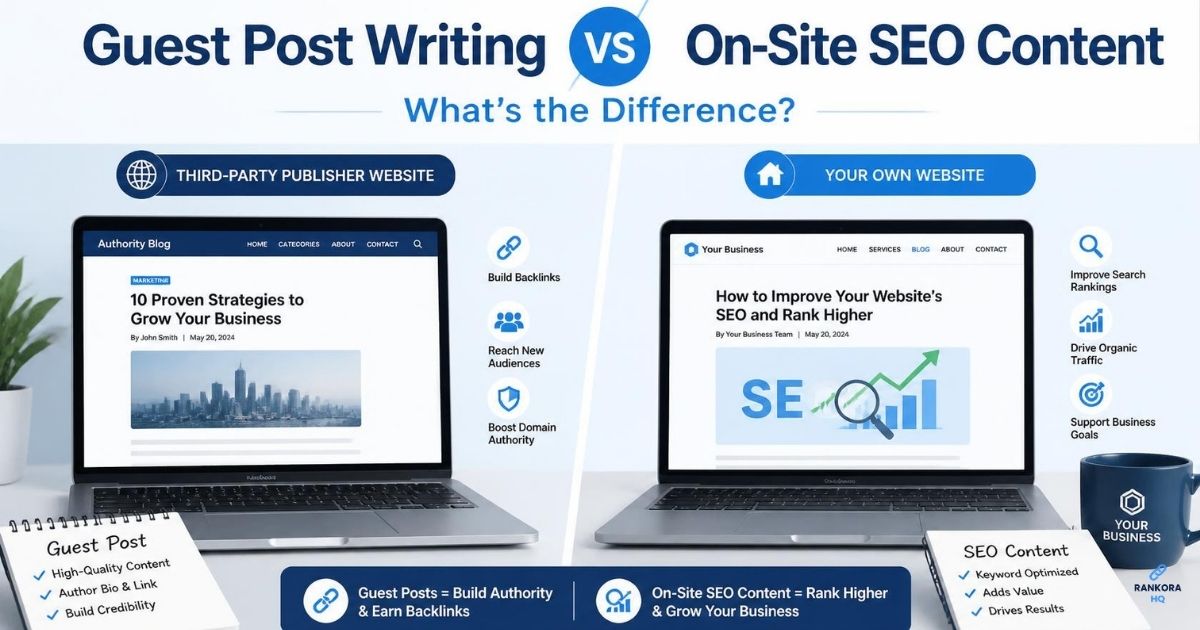
Guest post writing and on-site SEO content are not the same, even though both involve writing useful articles. The main difference is where the content lives, who it is written for, and what job it is supposed to do. In my experience working with agencies, this confusion often leads to weak content briefs, rejected guest posts, or blog articles that never support the actual SEO strategy.
This guide explains guest post writing vs SEO content in a clear, practical way. We will compare audience, ownership, editorial control, links, brand mentions, SEO goals, and update flexibility. By the end, you will know when an agency should create content for its own site and when guest post writing vs SEO content requires a completely different approach for a third-party publisher.
What Guest Post Writing vs SEO Content Means
Guest post writing vs SEO content comes down to purpose, audience, and control. A guest post is written for another website. On-site SEO content is written for your own website.
Both can support search visibility, but they are not built the same way. When agencies treat them as the same format, the content usually becomes too promotional for publishers or too shallow for their own site.
Guest post writing is created for a third-party publisher
Guest post writing means creating an article for a website you do not own. The content must fit that publisher’s audience, tone, topic style, and editorial rules.
That means the article cannot sound like a sales page. It should educate the reader first. Brand mentions, links, and examples need to feel natural inside the publisher’s content environment.
In my work with content placements, this is where many drafts fail. The idea may be good, but the article sounds too brand-focused for an editorial site.
On-site SEO content is created for your own website
On-site SEO content is content published on your own website. This includes blog posts, service-page support content, guides, comparison articles, and topical authority pieces.
Here, you control the structure, internal links, CTA placement, examples, screenshots, and update schedule. You can write directly for your own audience and connect the article to your services naturally.
For an agency, on-site content often supports rankings, lead generation, and buyer education. It helps prospects understand a problem before they contact you.
Why the same topic needs a different writing approach
The same topic can work as both a guest post and an on-site article, but the angle must change.
For example, an on-site article can explain how your agency handles SEO content planning. A guest post on the same topic should focus more on general lessons, industry examples, or practical advice for the publisher’s readers.
That is the real difference in guest post writing vs SEO content. One serves your own site strategy. The other earns attention inside someone else’s editorial space.
Audience and Search Intent Are Different
Audience is one of the biggest differences between guest post writing and on-site SEO content. A guest post speaks to someone else’s readers. On-site content speaks to your own prospects.
This changes the angle, tone, examples, and call to action. If the audience is different, the writing strategy must be different too.
Guest posts speak to the publisher’s readers
A guest post should be written for the publisher’s existing audience, not only for your client’s brand.
The reader may not know your company. They may not be ready to buy. They are usually reading because the topic helps them solve a problem, compare options, or learn something useful.
That is why editorial guest posts need a more neutral tone. The article should build trust first, not push the brand too early.
On-site content speaks to your own prospects
On-site SEO content is written for people who may become your leads, clients, or customers.
These readers are already on your website. They may be comparing your services, checking your expertise, or learning how you solve a specific problem.
Because of that, on-site content can connect more directly to your offers. You can add internal links, explain your process, and guide the reader toward a relevant next step.
How this changes tone, examples, and CTA placement
In guest post writing vs SEO content, tone and CTA placement matter a lot.
A guest post should use helpful examples that fit the publisher’s audience. The CTA should be soft, if allowed at all. A simple brand mention or relevant author bio is often enough.
On-site SEO content can be more direct. You can mention your service, link to a related page, and explain why your approach works. The key is to stay helpful, not pushy.
Ownership and Editorial Control
Ownership and editorial control are major differences between guest post content and on-site SEO writing. With on-site content, you control almost everything. With guest posts, the publisher has the final say.
This affects the structure, tone, links, formatting, and even how much your brand can be mentioned.
You fully control on-site SEO content
On-site SEO content belongs to your own website. You can decide the title, headings, keyword use, internal links, CTA, images, and update schedule.
This gives agencies more flexibility. If a page needs better examples, stronger internal links, or a new CTA, you can edit it anytime.
That control makes on-site content useful for long-term SEO planning and conversion support.
Guest posts must follow publisher guidelines
Guest posts are different because they are published on someone else’s site. The publisher controls the editorial standards.
They may limit promotional language, restrict links, change headings, request edits, or reject sections that do not match their tone.
This is normal. A strong guest post should feel like it belongs on the publisher’s website, not like copied brand content placed somewhere else.
Why edits, formatting, and approvals take longer for guest posts
Guest posts usually take longer because more people are involved. The agency, client, writer, editor, and publisher may all review the content.
Even small changes can require approval. A link may need to be adjusted. A brand mention may need softer wording. A heading may need to match the publisher’s style.
That is why contributed article writing needs cleaner briefs and tighter drafts from the start.
SEO Goals: Rankings vs Visibility
The SEO goal is different for each format. On-site SEO content is usually built to rank, support topical authority, and move readers toward conversion. Guest post writing is built to earn visibility, trust, referral traffic, and editorial mentions on another site.
This is why guest post writing vs SEO content should not be judged by the same metrics.
On-site content supports rankings, topical authority, and conversions
On-site SEO writing helps your own website cover important topics in depth. It can target keywords, answer buyer questions, support service pages, and build topical authority.
For example, an agency may publish blog content around content strategy, keyword research, link building, and reporting. Each article helps Google understand what the site is about.
On-site content can also guide readers toward a next step, such as reading a service page, booking a call, or requesting a quote.
Guest post content supports visibility, trust, referral traffic, and editorial mentions
Guest post content works differently. It helps your brand appear in front of a new audience on a relevant third-party website.
The goal is not always direct ranking for your own site. The value may come from referral traffic, brand exposure, expert positioning, and a natural editorial link.
A strong guest post should make the reader trust the idea first. The brand benefit comes from being associated with useful, credible content.
Why guest posts should not read like sales pages
Guest posts fail when they sound too promotional. Publishers do not want thin sales copy disguised as editorial content.
A guest post should teach, explain, compare, or solve a real problem. The brand mention should feel earned, not forced.
On-site SEO content can be more brand-led because it lives on your own website. Guest posts need more restraint because they must serve the publisher’s audience first.
Links and Brand Mentions
Links and brand mentions work differently in guest posts and on-site SEO content. On your own site, you control the linking structure. In a guest post, the publisher controls what is allowed.
This is one of the most practical differences in guest post writing vs SEO content.
On-site content gives more internal linking control
On-site SEO content gives you full control over internal links. You can link to service pages, related blog posts, case studies, contact pages, or product pages.
This helps users move through your website naturally. It also helps search engines understand how your pages connect.
For agencies, this control is valuable. A blog post can support a money page without sounding forced, as long as the link fits the topic.
Guest-post links depend on publisher rules
Guest-post links are not fully in your control. Some publishers allow one contextual link. Some only allow links in the author bio. Others may edit anchors or remove links that feel promotional.
That is why guest post content should be written to stand on its own. The article should still be useful even if the link placement is limited.
In my experience, publishers are more likely to accept links when they are relevant, natural, and helpful for the reader.
How to keep brand mentions natural and non-promotional
Brand mentions in guest posts should feel editorial, not like an advertisement.
A simple mention is often stronger than repeated brand promotion. The goal is to show expertise through the content, not force the company name into every section.
On-site content gives more room for brand positioning. Guest posts need more balance because the publisher’s trust comes first.
Updates and Long-Term Maintenance
Updates are much easier with on-site SEO content than guest post content. When the article is on your own website, you can improve it anytime. When it is published on another site, changes depend on the publisher.
This is an important part of guest post writing vs SEO content because content does not stay accurate forever.
On-site articles can be updated anytime
On-site SEO content is easier to maintain. You can update statistics, improve headings, add internal links, refresh examples, and change CTAs whenever needed.
This makes owned content more flexible for long-term SEO work. If rankings drop or the search intent changes, you can revise the article quickly.
For agencies, this matters because SEO content often needs regular updates to stay useful and competitive.
Guest posts depend on the publisher for changes
Guest posts are harder to update because they live on a third-party website. You may need to contact the editor or publisher for every change.
Some publishers respond quickly. Others may ignore update requests or charge extra for edits. Some may not allow changes after publishing.
That is why guest post content should avoid time-sensitive claims unless they are necessary.
Why this matters for outdated claims, stats, and offers
Old statistics, expired offers, outdated screenshots, and changed service details can weaken content.
On-site content can be fixed fast. Guest posts may stay live with old information if the publisher does not update them.
For this reason, guest posts should focus more on evergreen advice. On-site content can include more specific offers, process details, and conversion-focused updates.
Guest Post Content vs Blog Content: Quick Comparison
Guest post content and blog content can both support SEO, but they are built for different environments. The easiest way to choose the right format is to look at audience, ownership, links, updates, and the main goal.
Comparison table by audience, ownership, links, updates, and goal
| Factor | Guest Post Content | On-Site Blog Content |
| Audience | Publisher’s readers | Your own prospects |
| Ownership | Third-party website | Your own website |
| Editorial control | Limited | Full control |
| Links | Depends on publisher rules | Full internal linking control |
| Brand mentions | Usually limited | More flexible |
| Updates | Publisher approval needed | Can update anytime |
| Main goal | Visibility, trust, referral traffic, editorial mentions | Rankings, topical authority, leads, conversions |
This is why agencies should not use the same brief for both formats. A guest post needs to fit the publisher. A blog post needs to support the agency’s own website strategy.
When agencies should use on-site content
Agencies should use on-site SEO content when they want to build topical authority, rank for search terms, and educate potential clients.
This format works well for service guides, comparison articles, how-to content, case studies, and problem-solving blog posts.
For example, if an agency wants to rank for a service keyword, on-site content is usually the better format. It gives full control over keywords, internal links, CTAs, and future updates.
When agencies should use contributed article writing
Agencies should use contributed article writing when they want to reach a new audience on a relevant publisher’s website.
This format works well for expert insights, industry commentary, practical advice, and educational topics that fit the publisher’s readers.
A strong guest post should not feel like an ad. It should provide value first, then support the brand through a natural mention, author bio, or relevant editorial link.
Common Mistakes Agencies Should Avoid
Most problems happen when agencies use the same writing process for guest posts and on-site SEO content. The format may look similar, but the purpose is different.
A clear brief, proper angle, and realistic link expectations can prevent most content issues.
Writing guest posts like website landing pages
A guest post should not sound like a landing page. Publishers usually reject content that feels too promotional.
The article should educate first. Brand mentions should be light, natural, and relevant to the topic.
On-site content can explain your service more directly. Guest posts need a softer editorial style.
Using the same article for both formats
One article should not be copied across your site and a third-party publisher.
Even if the topic is similar, the structure and angle should change. Your own blog can focus on your process, offers, and buyer questions.
A guest post should focus on the publisher’s audience and provide broader educational value.
Overusing exact-match anchors
Exact-match anchor text can look unnatural when it is forced into guest post content.
A better approach is to use anchors that fit the sentence naturally. The link should support the reader, not interrupt the article.
For on-site content, you still need balance. Internal links should be useful, not stuffed into every paragraph.
Ignoring publisher tone and editorial rules
Every publisher has its own style. Some prefer short how-to articles. Others want expert commentary, data, or a more neutral tone.
Ignoring those rules creates delays and rejections. Before writing, check the publisher’s existing content, headings, link style, and promotional limits.
This is where guest post writing needs more preparation than normal blog writing.
Frequently Asked Questions
Is guest post writing the same as SEO content writing?
No. Guest post writing is created for a third-party publisher, while SEO content writing usually supports your own website’s rankings, topical authority, and conversions.
Can guest posts help SEO?
Yes, guest posts can support SEO through editorial links, brand mentions, referral traffic, and visibility on relevant websites.
Should guest posts target keywords?
Yes, but they should target keywords naturally. A guest post should still read like a helpful editorial article, not a keyword-stuffed SEO page.
Can I republish a guest post on my own blog?
Usually, no. Republishing the same article can create duplicate content issues and may also break the publisher’s content rules.
Which is better: guest post content or on-site blog content?
Neither is better in every situation. On-site content is better for rankings and conversions, while guest post content is better for visibility, trust, and third-party exposure.
Conclusion
Guest post writing and on-site SEO content may both involve article writing, but they are built for different jobs. On-site content gives you more control over rankings, internal links, conversions, and updates. Guest posts help you reach a third-party audience, earn trust, gain visibility, and support natural editorial mentions.
For agencies, the best choice depends on the goal. If you want to build your own topical authority, create on-site SEO content. If you want to appear in front of a relevant external audience, write a strong guest post that fits the publisher’s standards. When both formats are planned correctly, they can support each other without doing the same job.
If your agency needs help creating publisher-ready guest post content or SEO articles for client campaigns, Rankora HQ can support the writing, placement, and white-label reporting process.
Author Bio
Author: Muhammad Awais
Title: Founder, Rankora HQ
Muhammad Awais is the founder of Rankora HQ, a white-label editorial content placement service based in Salalah, Oman. He helps SEO agencies and brands build topical authority through high-quality publishing partnerships on DR 40-90 editorial sites.
LinkedIn: linkedin.com/in/muhammad-awais-seo-outreach