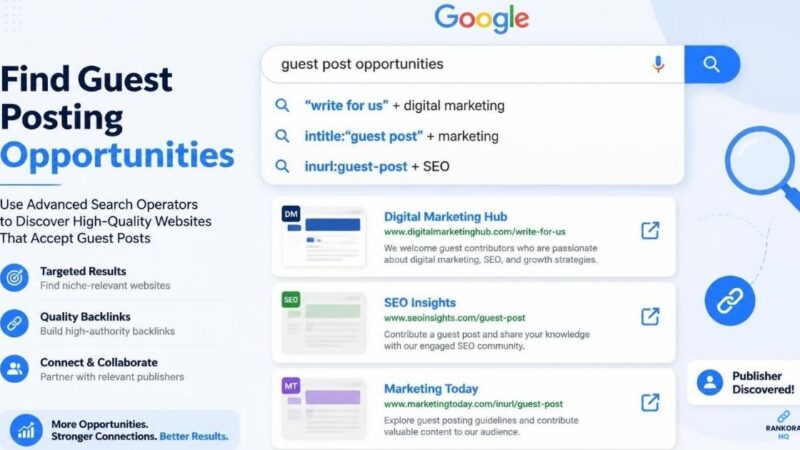
Finding the right websites is usually the hardest part of guest posting. Many agencies know they need placements, but they do not always know how to find guest posting opportunities that are actually relevant to their niche, audience, and SEO goals.
In my experience, the best process is not to chase random “write for us” pages. It is to build a clean discovery system. In this guide, I will show you how to find guest posting opportunities through Google search, competitor research, author footprints, relevant publications, and niche communities, so you can create a strong prospect list before moving into deeper publisher vetting.
What Are Guest Posting Opportunities?
Guest posting opportunities are websites, blogs, or online publications where you can contribute useful content and earn brand exposure, referral traffic, or a contextual backlink.
For SEO agencies, the goal is not just to find any site that accepts articles. The real goal is to find relevant publishers where the content makes sense for the client’s niche, audience, and authority goals.
Simple Definition for SEO Teams and Agencies
A guest posting opportunity is a potential publishing placement on another website.
That could be an industry blog, a niche magazine, a SaaS resource hub, a local business publication, or a contributor-based editorial site. In simple terms, it is a place where your content can be published in front of the right audience.
When I work on guest post prospecting, I treat each opportunity as a possible match first. I do not judge everything too deeply at the discovery stage. That comes later.
Guest Post Opportunities vs Random “Write for Us” Websites
Not every “write for us” website is a good guest post opportunity.
Some sites accept almost anything. Others cover too many unrelated topics. Some exist only to sell links, which can make them risky for agencies and clients.
A better guest posting opportunity has a clear topic focus, real content, and an audience that connects with your client’s industry. That is why discovery should always start with relevance, not just availability.
Why Relevance Matters Before Metrics
Relevance matters because a guest post should look natural on the publisher’s website.
A high-DR site is not always useful if it has no connection to your niche. For example, a cybersecurity SaaS brand should not chase a random lifestyle blog just because it accepts guest posts.
At this stage, the aim is simple: find possible publishers that match the topic. After that, you can move them into a deeper vetting process before making the final decision.
Start With the Type of Publishers You Actually Want
Before you search for guest post opportunities, define what a good publisher looks like for your niche.
This step saves time. It stops you from collecting random websites that may accept content but have no real connection to your client’s business, audience, or topic.
Define Your Niche, Audience, and Target Market
Start with three simple questions:
- What industry does the client serve?
- Who is the client trying to reach?
- Which countries or markets matter most?
For example, a B2B SaaS company should usually target SaaS blogs, startup publications, marketing sites, business technology blogs, and industry-specific software resources.
A local service business may need local publications, regional business blogs, trade sites, and niche directories with editorial content.
Separate Direct Industry Sites From Shoulder-Niche Sites
Direct industry sites are closely tied to the client’s main niche.
For example, a cybersecurity company publishing on a cybersecurity blog is a direct match.
Shoulder-niche sites are not the exact same niche, but they still share audience overlap. The same cybersecurity company could also fit on a business technology blog, SaaS publication, or IT management website.
Both types can be useful. The key is to make sure the connection feels natural.
Create Basic Prospect Criteria Before Searching
Before opening Google or any SEO tool, create a simple checklist.
You can include:
- Main niche
- Related topics
- Target country
- Preferred publisher type
- Minimum content quality
- Topics the site should already cover
This is not deep vetting. It is only a basic filter to guide discovery.
When I build prospect lists for agency clients, I prefer starting narrow first. Once the most relevant publishers are collected, I expand into related niches carefully.
How to Find Guest Posting Opportunities Using Google Search
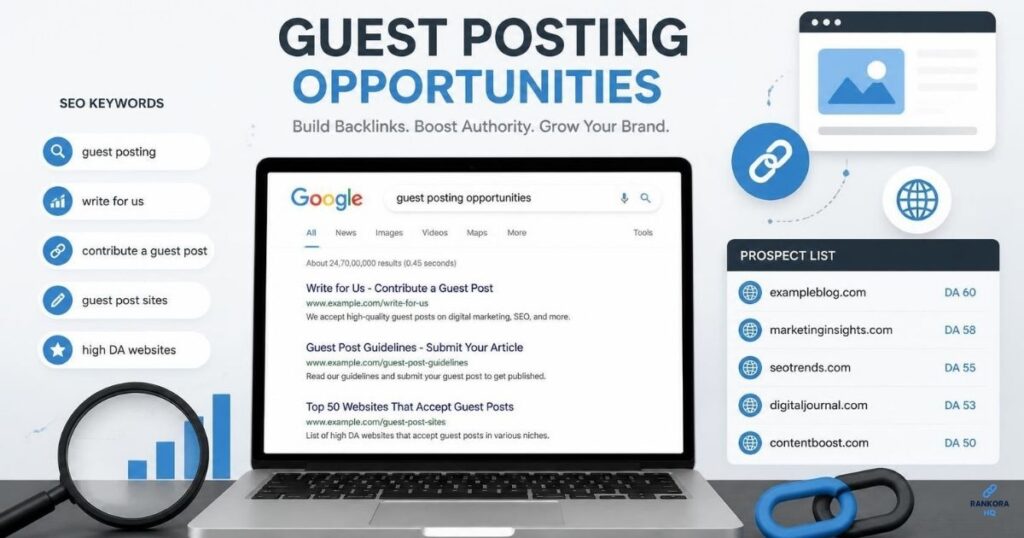
Google is still one of the amazing ways to find guest posting opportunities when you know what you need to search.
The mistake most people make is using only one search phrase and saving every result. A better approach is to test different search angles, collect possible websites, and organize them before doing deeper publisher vetting.
Use Simple Search Queries First
Start with basic searches around your niche.
For example, if your client is in the SaaS niche, you can search:
- SaaS blogs accepting guest posts
- SaaS write for us
- SaaS contributor guidelines
- SaaS guest post opportunities
- B2B software guest blogging opportunities
These searches help you find obvious publisher pages, contributor pages, and blogs that mention guest content.
Do not stop there. Basic searches are useful, but they usually show the same websites many other people are already contacting.
Use Advanced Search Operators
Search operators help you find more specific results.
You can use queries like:
- your niche + “write for us”
- your niche + “guest post”
- your niche + “contribute”
- your niche + “submit an article”
- your niche + “become a contributor”
- your niche + “editorial guidelines”
For example, instead of searching only “marketing guest post,” search “marketing + submit an article” or “marketing + contributor guidelines.”
This gives you more variety and helps you find relevant publishers that may not use the exact phrase “guest post.”
Search for Contributor Pages and Editorial Guidelines
Some good websites do not clearly say “guest posts accepted.”
They may use terms like:
- Contributor guidelines
- Editorial guidelines
- Submit content
- Become a writer
- Pitch an article
- Write for our blog
These pages often explain what topics the publisher accepts, who they write for, and how to pitch them.
At this stage, just save the website if it looks relevant. You can check quality, traffic, and link standards later.
Avoid Relying Only on “Write for Us” Searches
“Write for us” searches can help, but they should not be your only method.
Many low-quality websites use that phrase because they want to attract link buyers. Better editorial sites may accept expert contributions but never promote it with a public “write for us” page.
Save Every Possible Match Before Judging Too Deeply
The goal of Google search is discovery, not final approval.
Create a simple sheet and save each possible publisher with:
- Website name
- URL
- Niche
- Contact or guideline page
- Notes
- Source of discovery
Once the list is ready, you can remove irrelevant sites and move the better ones into a proper vetting process.
Use Competitor Research to Find Relevant Publishers
Competitor research helps you find guest post opportunities that are already active in your niche.
Instead of guessing where to publish, you look at where similar brands, agencies, or websites have already earned placements. This gives you a practical starting point for guest post prospecting.
Check Where Competitors Already Have Guest Posts
Start by choosing 3 to 5 competitors in your niche.
Search their brand name with terms like:
- competitor name + guest post
- competitor name + author
- competitor name + contributed article
- competitor name + interview
- competitor name + expert insights
You can also search for pages where their founder, marketer, or content lead has been mentioned as a contributor.
If a site has published your competitor, it may also be open to similar expert content.
Review Backlink Sources Without Copying Blindly
SEO tools can show you which websites link to your competitors.
The goal is not to copy every backlink. The goal is to spot publishers that may accept expert articles, contributed content, interviews, roundups, or niche resources.
Look for links from:
- Blogs
- Editorial websites
- Industry publications
- Resource pages
- Contributor articles
- Expert roundup posts
Skip anything that looks unrelated, spammy, or impossible to approach.
Look for Repeated Publisher Patterns in Your Niche
When you study several competitors, patterns start to appear.
You may notice that many brands in your niche are getting published on the same type of websites. For example, SaaS companies may often appear on startup blogs, product-led growth sites, marketing blogs, and software comparison resources.
These patterns help you understand where your audience already spends time.
That makes your prospecting more focused and less random.
Turn Competitor Links Into a Prospecting List
Once you find possible publishers, add them to your prospect sheet.
Include the website name, URL, content type, competitor example, and quick notes. Do not spend too much time judging the site yet.
At this stage, your job is to collect relevant options. Later, you can check traffic, content quality, outbound links, and overall publisher value before pitching.
Follow Author Footprints and Contributor Profiles
Author footprints help you find guest post opportunities by tracking where active contributors are already publishing.
This method works well because many writers, founders, and SEO teams publish across several relevant websites in the same niche. If you find one strong contributor, you can often find more publishers through their name.
Search Names of Active Guest Authors in Your Industry
Start with websites you already know in your niche.
Look at guest posts, contributor articles, expert roundups, and opinion pieces. Then copy the author’s name and search it on Google with terms like:
- “Author name” + “guest post”
- “Author name” + “contributor”
- “Author name” + “writes for”
- “Author name” + “author at”
- “Author name” + your niche
This can reveal other websites where the same person has published content.
Track Where Expert Contributors Are Publishing
Some contributors publish across many industry sites.
For example, in the SaaS niche, one marketer may write for startup blogs, growth marketing sites, software blogs, and business publications.
Each of those sites can become a possible guest post prospect.
Do not assume every site is ready to accept your pitch. At this stage, you are only discovering possible publishers.
Use Author Bios to Discover More Sites
Author bios often mention where else a person has been featured.
You may see lines like:
- Featured in popular marketing publications
- Contributor to SaaS and startup blogs
- Writes about SEO, content, and growth
- Published on leading industry websites
These clues can lead you to more relevant publications.
When I do guest post prospecting, I often use author bios as a trail. One good contributor profile can lead to five or ten more publishing opportunities.
Find Patterns Across LinkedIn, Google, and Publisher Pages
Do not rely on Google alone.
Check the author’s LinkedIn profile, portfolio, personal website, and publisher pages. Many contributors list their best articles or featured placements there.
Look for repeated site names, topic patterns, and publisher types.
If several trusted people in your niche are publishing on the same websites, those sites are worth adding to your prospect list for basic filtering.
Find Guest Blogging Opportunities Through Publications and Communities
Industry publications and niche communities can help you find guest blogging opportunities that do not always appear in basic Google searches.
This is useful because many good publishers do not openly advertise guest post pages. Instead, they build relationships with experts, founders, marketers, and regular contributors.
Search Industry Blogs, Magazines, and Editorial Sites
Start by listing the main publications in your niche.
These can include industry blogs, digital magazines, trade websites, SaaS blogs, startup publications, local business sites, and professional association blogs.
Then check what type of content they publish. Look for opinion pieces, expert guides, contributed articles, interviews, and founder stories.
If the site already publishes outside voices, it may be a possible guest post prospect.
Use LinkedIn, X, and Niche Communities Carefully
Social platforms can reveal active publishers and editors.
Search for phrases like:
- Looking for contributors
- Accepting pitches
- Guest article
- Contributor opportunity
- Write for our blog
LinkedIn and X are especially useful for finding editors, content managers, and niche site owners.
Do not pitch immediately. First, study what they publish and how they talk about contributors.
Check Slack Groups, Facebook Groups, Reddit, and Forums
Niche communities often share publishing opportunities before they appear on search engines.
For example, SEO groups, SaaS communities, startup forums, and local business groups may include editors asking for expert input or contributed content.
Use these spaces to observe first. Look for repeated website mentions, open calls for writers, and discussions about trusted industry blogs.
This gives you a more natural way to discover relevant publishers.
Build Relationships Before Asking for Placement
Cold prospecting works, but relationships make it easier.
Comment on posts. Share useful insights. Join discussions. Support the publisher’s content before sending a pitch.
When I prospect for agency clients, I prefer building context before outreach whenever possible. A warm pitch usually feels more natural than a random email from someone asking for a backlink.
Build and Organize Your Guest Post Prospecting List
A guest post prospecting list keeps your discovery work clean, trackable, and easy to review.
Without a list, you will lose good websites, contact the same publisher twice, or mix strong prospects with weak ones. A simple sheet gives your process structure before outreach begins.
What to Add to Your Prospect Sheet
Your prospect sheet does not need to be complex.
Start with these basic columns:
- Website name
- Website URL
- Niche or category
- Relevant page URL
- Contact page or editor email
- Example article
- Discovery source
- Notes
- Status
The goal is to collect useful information in one place. You can add deeper SEO metrics later during publisher vetting.
Group Sites by Niche, Relevance, and Outreach Status
Once you have enough prospects, group them properly.
For example, you can separate sites into:
- Direct niche publishers
- Shoulder-niche publishers
- Industry blogs
- Local publications
- Community-driven websites
Then add a simple outreach status, such as “new,” “reviewing,” “approved,” “pitched,” or “not suitable.”
This makes the list easier to manage when you start pitching.
Add Notes Before Sending Any Pitch
Notes help you personalize outreach later.
Write down what the site publishes, which topics appear often, and why the website may fit your client. You can also note the editor’s name, content style, or recent article ideas.
This step saves time because you are not starting from zero when it is time to write the pitch.
Use a Simple Workflow From Discovery to Approval
A clean workflow keeps prospecting separate from final publisher selection.
Here is the basic flow I use:
- Discover possible websites
- Add them to the prospect list
- Remove clearly irrelevant sites
- Shortlist the best matches
- Move shortlisted publishers into deeper vetting
- Approve the final sites before outreach or placement
This keeps the process focused. You are not trying to judge everything at once. You are building a strong list first, then checking publisher quality in the next stage.
Apply Basic Relevance Filters Before Vetting
Basic filtering helps you remove poor matches before you spend time on full publisher evaluation.
At this stage, you are not checking every SEO metric in detail. You are only asking one simple question: does this website look relevant enough to move forward?
Remove Clearly Irrelevant Websites
Start by removing websites that have no natural connection to your niche.
If the topic match feels forced, remove it from the list. Relevance should come before convenience.
Check if the Site Publishes Your Topic Type
A site may be in your industry but still not fit your content angle.
Look at its recent articles. Check whether it publishes guides, expert opinions, case studies, list posts, interviews, or thought leadership content.
If your topic would look normal beside their existing content, keep the site for the next step.
Look at Recent Content Freshness
Fresh content is a basic sign that the site is active.
Check when the latest articles were published. If the blog has not been updated for months or years, it may not be worth prioritizing.
Keep Deep Publisher Evaluation for the Next Step
Do not turn this stage into a full quality audit.
Detailed checks like organic traffic, link profile, outbound link patterns, content quality, indexing, and spam signals belong in publisher vetting.
Here, the goal is only to clean your prospect list.
When to Move Prospects Into Full Publisher Vetting
Move a website into full vetting when it passes the basic relevance check.
A good shortlisted prospect should have:
- A clear niche connection
- Active content
- Topics that match your client
- A realistic reason to pitch
- Some sign of editorial publishing
Once a site passes these simple filters, you can review its quality properly before outreach or placement.
Common Guest Post Prospecting Mistakes to Avoid
Most guest post prospecting mistakes happen when people rush the discovery stage.
They collect websites too quickly, chase easy placements, or judge publishers before they even understand whether the site is relevant. A better process keeps discovery simple, organized, and niche-focused.
Chasing DR Before Relevance
DR can be useful later, but it should not lead the discovery process.
A high-DR website with no topical connection can look strong in a report but weak in real SEO value. Relevance should come first because the placement needs to make sense for the reader, the publisher, and the client.
At this stage, ask: “Would this website normally publish content about this topic?” If the answer is no, remove it.
Using Only Curated Guest Post Lists
Curated lists can save time, but they are rarely enough.
Many of these lists are outdated, overused, or filled with websites that receive too many guest post pitches. Some publishers also change their guidelines, pricing, or editorial standards over time.
Mixing Prospecting With Full Quality Auditing Too Early
Prospecting and vetting are not the same task.
Prospecting means finding possible websites. Vetting means deciding whether those websites are actually worth using.
Sending Outreach Before Understanding the Publisher
Many pitches fail because the sender does not understand the website.
Before outreach, check what the publisher writes about, who their audience is, and what type of content they usually accept.
A generic pitch feels lazy. A focused pitch shows that you understand the site and can offer something useful.
Ignoring Niche Communities and Author Trails
Google is useful, but it will not show every opportunity.
Some of the best guest post opportunities come from communities, contributor networks, LinkedIn activity, and author footprints.
When you follow active writers and niche discussions, you often find publishers that competitors miss. That gives your prospect list more depth and better variety.
Frequently Asked Questions
How do I find guest posting sites in my niche?
Start with Google search, competitor backlink research, author footprints, and niche communities. Then save every relevant website in a prospecting sheet before you vet them.
What is the best way to find guest post opportunities?
The best way is to combine several discovery methods instead of relying on one source. Use search operators, competitor research, industry publications, and contributor profiles together.
Are “write for us” pages still useful?
Yes, but they should not be your only source. Many strong publishers accept expert contributions without using the phrase “write for us.”
How do competitors help with guest post prospecting?
Competitors show you where similar brands are already getting published. These websites can become useful prospects if they match your niche and audience.
How many guest post prospects should I collect?
For one niche, start with 50 to 100 possible websites. After basic filtering and vetting, the final shortlist will usually be much smaller.
What should I check before pitching a guest post site?
Check basic relevance, recent content, topic fit, and whether your article idea matches their audience. Save deeper checks like traffic and link quality for publisher vetting.
Should I use guest post marketplaces to find opportunities?
You can use them for research, but do not depend on them blindly. Always check whether the publisher is relevant and worth reviewing before you pitch or buy a placement.
Conclusion
Finding guest post prospects gets easier when you follow a clear system. Start with your niche, search with different angles, study competitors, follow author footprints, and look inside real communities where publishers and contributors are active.
The goal is not to approve every website during discovery. The goal is to build a clean list of relevant publishers, remove weak matches, and then move the best prospects into proper vetting. If you want a transparent, agency-friendly process, Rankora HQ’s guest posting service for agencies can help you find and manage relevant editorial placements with approval at every step.
Author Bio
Muhammad Awais is the founder of Rankora HQ, a white-label editorial content placement service based in Salalah, Oman. He helps SEO agencies and brands build topical authority through high-quality publishing partnerships on DR 40-90 editorial sites.