Publishing an article is only the first step. The real question is what happens after Google finds it, tests it, and starts showing it for search queries. In my experience, agencies need a clear way to measure SEO content performance before deciding whether a page should be updated, improved, consolidated, or left alone.
To measure SEO content performance properly, you need to look beyond traffic. Impressions, clicks, search queries, rankings, engagement, and assisted conversions all tell part of the story. In this guide, I’ll show you how to measure SEO content performance at the article level, so you can judge whether one published page is actually doing its job.
What SEO Content Performance Means
SEO content performance means how well one published page performs in search after it goes live. It is not just about whether the article gets traffic. A page can bring visitors and still fail if it ranks for the wrong queries, attracts the wrong audience, or does not support the next step.
When I measure SEO content performance for an article, I look at the full picture: visibility, clicks, rankings, query relevance, engagement, and assisted conversions. These signals show whether the content is actually helping the website grow.
Content Performance Is More Than Traffic
Traffic is useful, but it is not the whole story.
An article with low traffic may still be valuable if it ranks for a high-intent keyword, supports a service page, or assists conversions. On the other side, an article with high traffic may not be useful if users leave quickly or never move deeper into the site.
That is why agencies should not judge content by sessions alone. They need to ask better questions:
- Is the article getting impressions?
- Are people clicking from Google?
- Is it ranking for the right queries?
- Are users engaging after they land?
- Does it help leads, sales, or internal authority?
These answers show the real performance of the page.
Article-Level Measurement vs Full SEO Reporting
Article-level measurement focuses on one published URL. It tells you whether that specific page is working, weak, or needs improvement.
Full SEO reporting is different. That includes wider client reporting, dashboards, campaign summaries, backlinks, technical health, and overall SEO progress. Those reports are important, but they are not the main focus here.
For this guide, the goal is simple: understand whether one article is performing well in SEO and decide what to do next.
When Should You Measure a Published Article?
You should measure a published article after it has had enough time to be indexed, tested, and shown for real search queries. SEO content does not usually give clear signals the day it goes live.
In my experience, the first few weeks are mostly about data collection. Google may test the page for different queries, move it between positions, and slowly decide where it fits. That is why early numbers can be misleading.
Do Not Judge Content Too Early
A new article needs time before you can fairly call it successful or weak.
If you check too soon, you may see low clicks, unstable rankings, or no conversions. That does not always mean the content failed. It may simply mean the page has not collected enough impressions or query data yet.
For most articles, I prefer to wait until there is enough Search Console data to see patterns. The main question is not “Did this get traffic fast?” The better question is “Is Google starting to understand and test this page for the right search intent?”
Use the Right Review Windows
A simple review window keeps the measurement process clean.
Use 30 days to check early visibility. Look for impressions, first clicks, and the search queries Google is testing.
Use 90 days to judge direction. By this point, you should see whether clicks, CTR, average position, and query relevance are improving.
Use 6 months to make stronger decisions. This is where you can decide whether to update, improve, consolidate, or maintain the article.
The goal is not to review content every day. The goal is to measure SEO content performance with enough data to make a smart decision.
Key Metrics to Measure SEO Content Performance
The best way to measure SEO content performance is to review the signals that show visibility, traffic quality, ranking movement, and user value. One metric alone is never enough.
When I review a published article, I do not start with “How much traffic did it get?” I start with “What is Google showing this page for, and are the right users responding?”
Impressions
Impressions show how often the article appears in Google search results.
If impressions are increasing, Google is testing the page for more queries. That is usually a good early sign, even if clicks are still low.
Low impressions may mean the page is not indexed properly, the keyword is too competitive, or the content does not match enough searchable intent.
Clicks and CTR
Clicks show how many users visited the article from search.
CTR shows how many people clicked after seeing it in Google. If impressions are high but clicks are low, the issue may be the SEO title, meta description, or search intent match.
This is where small improvements can help. A clearer title or stronger angle can often improve clicks without rewriting the full article.
Average Position and Rankings
Average position shows where the article usually appears in search results.
If the article is moving from position 40 to 18, that is progress. It may not bring much traffic yet, but it shows Google is starting to understand the page.
If the page is stuck on page two, the content may need stronger internal links, better topical depth, or a clearer answer to the main query.
Search Queries
Search queries show what people typed before finding the article.
This is one of the most useful signals in Google Search Console. It tells you whether the article is ranking for the right intent.
If the queries match the article’s goal, the page is on the right path. If the queries are unrelated, the content may need to be refocused.
Engagement and Assisted Conversions
Engagement shows what users do after they land on the article.
Look at engagement time, scroll behavior, internal clicks, and assisted conversions. These signals help you understand whether readers found the content useful.
An article does not always need to convert directly. Sometimes its job is to educate the reader, support a service page, and move the visitor one step closer to becoming a lead.
How to Measure SEO Content Performance in Google Search Console
Google Search Console is the first tool I check when I want to measure SEO content performance for one published article. It shows how the page is appearing in search before users even land on the website.
The key is to review the article at the URL level, not the full site level. This keeps the analysis focused on one page and avoids mixing article performance with the rest of the website.
Check the URL-Level Performance Report
Start by opening the article URL inside Google Search Console’s performance report.
Then review the main signals:
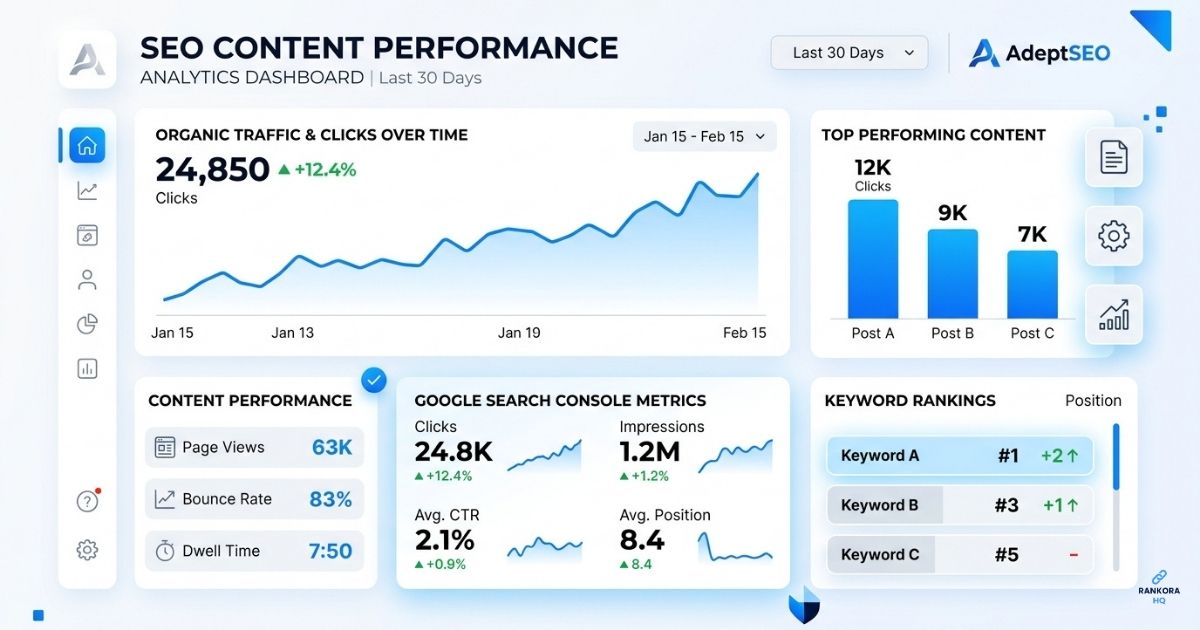
- Total impressions
- Total clicks
- Average CTR
- Average position
- Ranking search queries
This gives you a clean view of how that specific article is performing in Google search.
If the article has impressions but very few clicks, Google is showing it, but users are not choosing it. If it has low impressions, the page may need better indexing, stronger internal links, or more relevant content depth.
Compare Queries, Clicks, Impressions, CTR, and Position
Search queries show what Google thinks the article is about.
This is where many agencies find the real issue. An article may rank, but not for the keyword or intent it was written for. That means the content may need to be adjusted around the right topic.
Look for patterns:
- High impressions and low CTR may mean the title is weak.
- Good position and low clicks may mean the search intent is not strong.
- Low position but relevant queries may mean the article needs more depth.
- Irrelevant queries may mean the content is too broad or unclear.
These signals help you diagnose the page instead of guessing.
Find Content Gaps From Real Search Queries
Google Search Console can also show missing content opportunities.
If users are finding the article through related questions or subtopics, check whether the page answers them clearly. If not, those queries can guide your next update.
This is one of the simplest ways to improve a published article. You are not adding random content. You are improving the page based on real search data.
What Google Analytics Shows After the Click
Google Search Console shows how the article performs in search. Google Analytics shows what users do after they click.
This matters because clicks alone do not prove content quality. A page may bring traffic, but if readers leave quickly or never move deeper into the site, the article may not be doing its job.
Engagement Time and Scroll Behavior
Engagement time shows whether visitors are staying on the article long enough to read it.
If engagement time is very low, the content may not match the search intent. The introduction may be weak, the answer may be buried, or the page may not give users what they expected.
Scroll behavior can also help. If users do not move far down the page, the content may need a stronger opening, clearer structure, or better internal links.
Conversions and Assisted Conversions
Not every article converts directly.
Some content supports the buyer journey by answering questions, building trust, and sending users toward a service page. That is why assisted conversions matter.
For example, an article may not be the final page before a lead submits a form. But it may be the first page that brought the visitor to the site or helped them understand the service better.
Why Traffic Alone Can Mislead Agencies
Traffic can look good in a report, but it does not always mean the article is valuable.
If the page attracts the wrong audience, ranks for weak queries, or creates no next step, the traffic may not help the business. That is why agencies should connect traffic with engagement, internal clicks, and conversion support.
Good SEO content does not only bring visitors. It brings the right visitors and helps them take the next useful step.
How to Decide What to Do Next
After you measure the article, the next step is to choose the right action. Do not update content just because traffic is low. First, understand what the data is saying.
Most published articles need one of four actions: update, improve, consolidate, or maintain.
Update the Article
Update the article when the information is outdated, rankings are dropping, or the search intent has changed.
This may include refreshing examples, adding newer data, improving outdated advice, or adjusting the content to match what searchers now expect.
A good update keeps the page relevant without changing its main purpose.
Improve the Article
Improve the article when it has visibility but weak performance.
For example, the page may have good impressions but low clicks. That usually means the title, meta description, or opening angle needs work.
If the page gets clicks but poor engagement, the content may need clearer answers, better structure, stronger internal links, or more useful examples.
Consolidate the Article
Consolidate the article when two or more pages compete for the same search intent.
This usually happens when similar blog posts target overlapping keywords. Instead of letting them fight each other, combine the strongest parts into one better page.
After consolidation, redirect the weaker URL and make sure the final page has a clear focus.
Maintain the Article
Maintain the article when it is stable and still doing its job.
If rankings, clicks, engagement, and query relevance are healthy, do not make unnecessary changes. Sometimes the best decision is to leave the page alone and monitor it later.
Good content measurement is not about constant editing. It is about making the right decision based on real performance data.
Common Mistakes to Avoid
The biggest mistake agencies make is measuring content without knowing what the page was supposed to achieve. Every article should be judged against its own purpose, keyword intent, and performance signals.
If you skip that step, you may update the wrong page, remove useful content, or report numbers that do not explain the real issue.
Measuring Too Soon
Do not judge an article before it has enough data.
A new page needs time to get indexed, collect impressions, and rank for search queries. If you review it too early, the data may look weak even when Google is still testing the page.
Looking Only at Organic Traffic
Organic traffic is important, but it is not the full picture.
A page with fewer visits can still perform well if it ranks for the right query, supports a service page, or brings qualified users. Always check impressions, CTR, rankings, queries, and engagement before making a decision.
Ignoring Search Intent Mismatch
Search queries can reveal when an article is drifting away from its original purpose.
If the page ranks for unrelated terms, the content may be too broad. If it gets impressions but no clicks, the title or angle may not match what users want.
Intent mismatch should be fixed before rewriting the whole article.
Turning This Into Full SEO Reporting
This guide is about measuring one article, not building a full client SEO report.
Client reporting covers broader areas like campaign performance, dashboards, backlinks, technical SEO, and monthly summaries. Article-level measurement is narrower. It answers one question: did this specific piece of content perform in search?
Frequently Asked Questions
What is SEO content performance?
SEO content performance shows how well one published page earns search visibility, clicks, rankings, engagement, and business value after it goes live.
How do you measure SEO content performance?
You measure SEO content performance by checking impressions, clicks, CTR, average position, search queries, engagement, and assisted conversions.
Which SEO content metrics matter most?
The most useful metrics are impressions, clicks, CTR, average position, ranking queries, engagement time, internal clicks, and conversion support.
How long should you wait before reviewing an article?
For early signals, review after 30 days. For stronger decisions, review after 90 days or 6 months, depending on the site and keyword difficulty.
Should low-traffic content always be updated?
No. Low-traffic content may still be useful if it ranks for the right intent, supports a service page, or helps qualified users move deeper into the site.
What is the difference between content performance and SEO reporting?
Content performance looks at one article or URL. SEO reporting covers the bigger campaign, including traffic, rankings, backlinks, technical SEO, and client-level results.
Conclusion
Measuring SEO content performance is not about checking traffic once and making a quick judgment. A published article should be reviewed through the right signals: impressions, clicks, CTR, search queries, rankings, engagement, and assisted conversions.
When you look at these signals together, it becomes easier to decide what the article needs next. Some pages need an update. Some need better structure or stronger intent matching. Some should be consolidated. And some should simply be maintained because they are already doing their job.
At Rankora HQ, I use this same practical approach when creating and reviewing SEO content for agencies. The goal is simple: publish content that does not just exist, but performs with a clear purpose.
Author Bio:
Muhammad Awais is the founder of Rankora HQ, a white-label editorial content placement service based in Salalah, Oman. He helps SEO agencies and brands build topical authority through high-quality publishing partnerships on DR 40-90 editorial sites.