A niche edit quality checklist helps SEO agencies decide whether a link insertion is relevant, safe, and worth approving before it goes live. In my experience, most niche edit problems do not come from the link itself. They come from weak page relevance, forced context, poor anchor choices, or placements that were never properly checked.
That is why I treat every placement as a small editorial decision, not just a backlink order. In this guide, I’ll walk through the exact niche edit quality checklist agencies can use before approval, during content review, and after publication. A clear niche edit quality checklist protects client trust, improves reporting, and helps agencies avoid placements that look good on paper but fail in practice.
Why niche edit quality matters
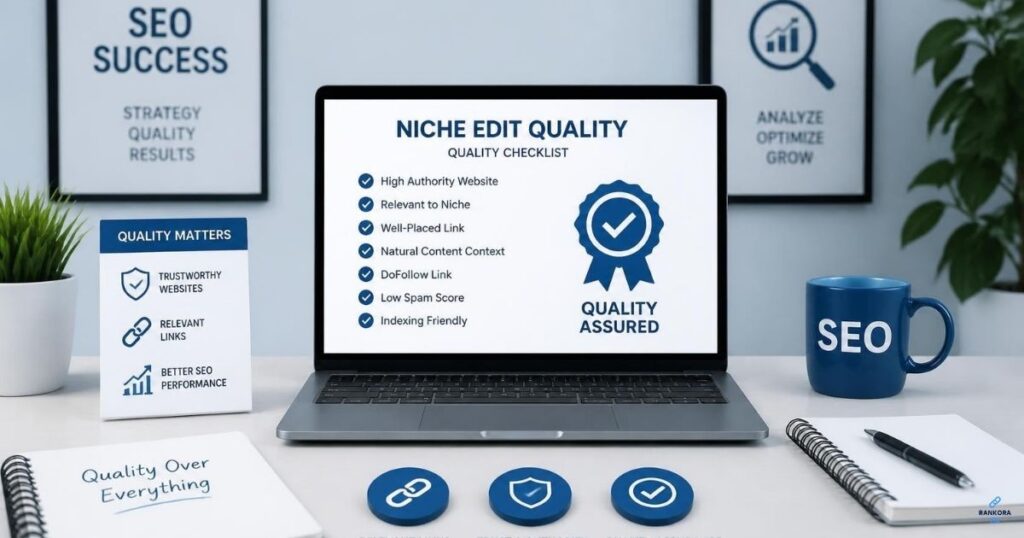
Niche edit quality matters because agencies are not just buying a link. They are approving a placement that will represent the client’s website, brand, and SEO strategy.
A strong niche edit should fit the page naturally. It should support the reader, match the topic, and point to a useful destination. If the placement feels forced, the link may create more risk than value.
A bad niche edit can hurt client trust
A poor niche edit is easy for a client to question. If the page is irrelevant, overloaded with links, or written badly, the client may wonder why it was approved in the first place.
That is why I never treat niche edits as a volume task. Every placement needs a simple review before it goes live. Agencies should check the page, the context, the anchor text, and the final link destination.
Placement quality matters more than just getting a link
Getting the link is not the real win. Getting the right link in the right context is what matters.
A proper niche edit quality checklist helps agencies avoid weak placements before they reach the client. It also makes reporting easier because the team can explain why the link was approved, where it was placed, and how it supports the campaign.
Before approval: Niche edit quality checklist
Before approving a niche edit, agencies should check the page the same way they would check a client-facing deliverable. The goal is simple: make sure the placement is relevant, natural, and safe enough to send to the client.
I use this stage to reject weak opportunities early. It is much easier to decline a poor placement before publishing than to explain it after the client sees the report.
Check website relevance
The website should have a clear connection to the client’s niche, audience, or topic area. It does not need to be an exact match, but the connection should make sense.
DR alone is not enough. A high-DR site with poor relevance can still be a bad placement.
Review page-level topic match
The page itself matters more than the domain homepage. A relevant website can still have an irrelevant article.
Before approving the edit, read the title, headings, and surrounding section. Ask one question: would this link help a real reader understand the topic better?
If the answer is no, the placement is probably forced.
Look at traffic and visibility signals
A niche edit is stronger when the page has some visibility. This can include organic traffic, ranking keywords, or signs that Google has already found value in the page.
The page does not need huge traffic. But it should not look dead, hidden, or completely ignored.
Check outbound link patterns
Outbound links reveal a lot about page quality. If the article is packed with unrelated links, casino links, payday links, or random commercial anchors, I would reject it.
A clean page usually links to relevant sources in a natural way. The links support the content instead of turning the page into a link farm.
This is one of the fastest checks in a niche edit quality checklist. If the outbound link pattern looks suspicious, the placement is not worth defending.
Content-level quality checks
Content-level QA shows whether the niche edit actually belongs on the page. Even if the website looks relevant, the link can still fail if the surrounding content feels forced.
This is where agencies should slow down and read the section like an editor, not just an SEO.
Check the paragraph around the link
The paragraph around the link should make the placement feel natural. It should explain, support, or introduce the target page in a way that helps the reader.
If the link appears in a random sentence with no clear reason, the placement is weak. A good niche edit should feel like it was always part of the article.
Make sure the link fits naturally
The link should match the topic of the sentence and the intent of the page. It should not interrupt the flow or suddenly shift the article into a different subject.
Avoid thin or rewritten content
Some niche edits are placed inside newly added text that looks rushed or rewritten. This can make the whole placement feel unnatural.
Reject content that sounds generic, awkward, or added only to hold the link. A strong edit should improve the article, not damage its quality.
Link placement review checklist
Link placement review is where agencies check the actual link details before approval. The page may be relevant, but the placement can still fail if the anchor, URL, or link position looks unnatural.
This part of the niche edit quality checklist keeps the review practical. The link should make sense for the reader and support the client’s SEO goal.
Review anchor text
The anchor text should match the topic of the page and the destination URL. It should feel natural inside the sentence.
Avoid anchors that are too exact, too long, or clearly written only for search engines. A good anchor gives context without making the placement look forced.
Check the target URL
The target URL should be useful and relevant to the article. It should not send readers to a thin, unrelated, or overly sales-focused page.
Before approval, open the client URL and check if it matches the promise of the anchor text. If the anchor says “SEO content writing service,” the page should clearly support that topic.
Confirm placement location
The link should appear inside the main body content, not in a footer, author box, sidebar, or random list.
A strong placement usually appears in a relevant paragraph where the reader already expects more information. If the link is buried in a weak section, its value is harder to defend.
Review link attributes
Check whether the link is dofollow, nofollow, sponsored, or UGC. Agencies should know this before reporting the placement to a client.
There is nothing wrong with documenting link attributes clearly. The problem is delivering a placement without checking what type of link was actually published.
Red flags to reject a niche edit
Some niche edits should be rejected before they reach the client. If the placement looks unnatural, irrelevant, or risky, it is better to walk away than include it in a report.
A clear rejection process protects agency standards and avoids weak links that are hard to explain later.
Irrelevant pages
Reject the placement if the page has no clear connection to the client’s topic. A link should not appear only because there is space for it.
The article should give the reader a real reason to visit the target URL. If the link feels random, the placement is not strong enough.
Too many outbound links
A page with too many outbound links can look low-quality. This is especially true when the links point to unrelated industries or commercial pages.
If the article feels like a link dump, avoid it. A niche edit should sit inside useful content, not among dozens of paid-looking links.
Sudden topic changes
A sudden topic shift is one of the easiest signs of a forced edit. The article may start on one subject, then quickly move into an unrelated sentence just to add the link.
This breaks editorial flow. It also makes the placement look obvious to clients, readers, and search engines.
Suspicious placement patterns
Be careful with websites that repeat the same type of link placement across many articles. This can include exact-match anchors, copied sentences, or links added in the same paragraph style every time.
A good niche edit should feel specific to the page. If the pattern looks manufactured, reject it.
After placement: Post-publication QA
Post-publication QA confirms that the approved niche edit was published correctly. Agencies should not send a client report until the live placement has been checked.
This step is simple, but it prevents common delivery issues like wrong anchors, broken URLs, missing links, or changed link attributes.
Confirm the link is live
Open the final published URL and check the placement manually. Do not rely only on a publisher confirmation.
Make sure the link appears on the correct page, in the correct paragraph, with the approved anchor text and target URL.
Check indexing and crawl visibility
The page should be accessible and visible to search engines. If the page is blocked, noindexed, or hidden from crawlers, the placement may have limited SEO value.
Agencies do not need to overcomplicate this step. A basic index and crawlability check is enough for most niche edit QA.
Save placement records
Save the live URL, anchor text, target URL, link attribute, placement date, and screenshot. These details make reporting cleaner and protect the agency if the link changes later.
For white-label work, this record also helps the agency present the placement under its own brand with confidence.
Monitor link changes
A niche edit can change after delivery. The link may be removed, edited, changed to nofollow, or moved to a weaker section of the page.
That is why agencies should review important placements after publication. A strong niche edit quality checklist does not end when the link goes live.
Simple niche edit QA workflow for agencies
A niche edit QA workflow helps agencies review every placement the same way. Without a repeatable process, quality depends too much on the person checking the link.
The goal is not to make the process complicated. The goal is to make sure no weak placement reaches the client without review.
Build one repeatable approval process
Use the same approval steps for every niche edit. Check the website, page relevance, content context, anchor text, target URL, and final placement details.
Keep client reporting clear
Client reports should show the final URL, anchor text, target page, link attribute, and placement date. Screenshots are also useful when the client wants proof of placement.
Review every placement before delivery
Never send a niche edit report without checking the live page first. A placement can be approved correctly but published with the wrong anchor, wrong URL, or wrong link attribute.
One final review protects the agency from simple mistakes. It also keeps the niche edit quality checklist useful from approval to delivery.
Frequently Asked Questions
What is a niche edit quality checklist?
A niche edit quality checklist is a review process agencies use to check relevance, content context, anchor text, and final link placement before approval.
How do agencies check niche edit quality?
Agencies check the website, page topic, surrounding paragraph, outbound links, anchor text, target URL, and live placement details.
What makes a niche edit look natural?
A niche edit looks natural when the link fits the sentence, supports the article topic, and helps the reader find useful related information.
What red flags should agencies reject?
Agencies should reject irrelevant pages, forced topic changes, too many outbound links, suspicious anchors, and low-quality rewritten content.
Should agencies check niche edits after publishing?
Yes. Agencies should confirm the link is live, the anchor and URL are correct, and the page is still accessible after publication.
Conclusion
A niche edit can look simple from the outside, but quality depends on the details. Agencies need to check relevance, page context, anchor text, target URL, link attributes, and the final live placement before sending anything to a client.
A clear niche edit quality checklist makes that process easier. It helps teams reject weak placements, approve better ones, and keep reporting clean. At Rankora HQ, I use this kind of review process to make sure every link insertion is checked before it becomes part of a client campaign.
Author Bio:
Muhammad Awais is the founder of Rankora HQ, a white-label editorial content placement service based in Salalah, Oman. He helps SEO agencies and brands build topical authority through high-quality publishing partnerships on DR 40-90 editorial sites.
LinkedIn: linkedin.com/in/muhammad-awais-seo-outreach