A finished draft is not always ready to publish. Before an article goes live, it needs one final review to make sure the title, structure, links, metadata, images, and technical settings all support the main search intent.
This SEO content optimization checklist helps you check the important details before publishing. I use a similar SEO content optimization checklist when reviewing content for agencies, because small issues like weak headings, missing internal links, or unclear metadata can quietly reduce the value of an otherwise strong article.
What Is an SEO Content Optimization Checklist?
An SEO content optimization checklist is a final review process you use before publishing a finished article.
It helps you check whether the page is clear, useful, searchable, and ready for readers. I use it as a quality gate before content goes live, especially when working on agency content where one missed detail can affect the whole publishing workflow.
Simple Definition
An SEO content optimization checklist is a step-by-step review of the most important on-page content elements.
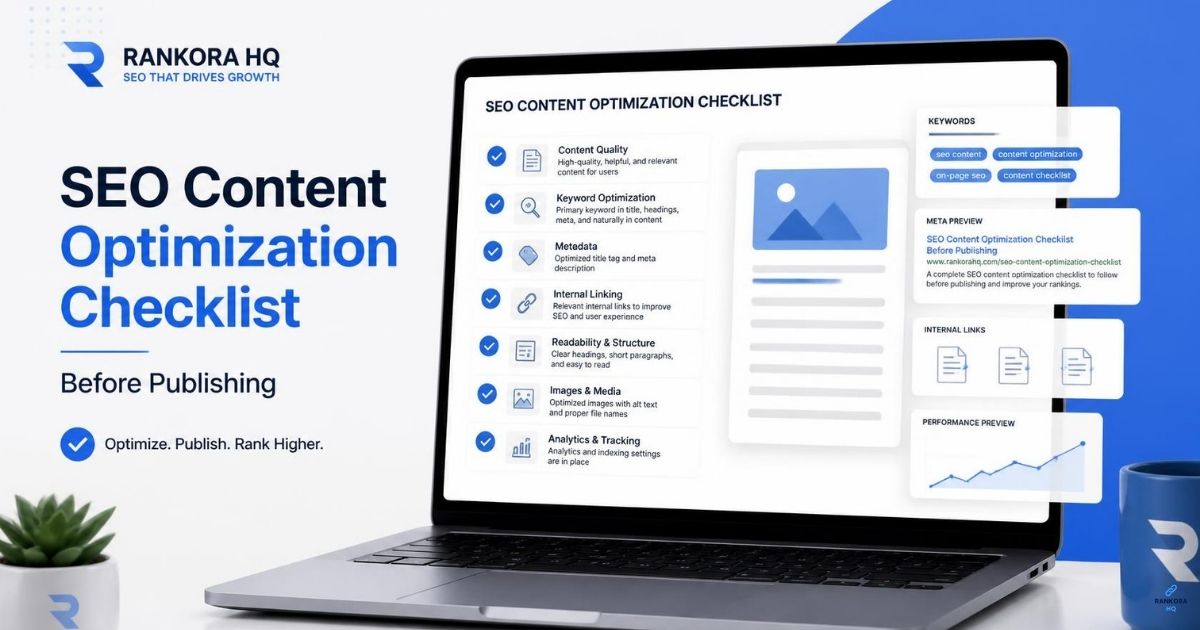
It covers things like:
- Search intent
- SEO title
- H1 and headings
- Keyword usage
- Internal links
- External sources
- Images and alt text
- Meta description
- Schema and indexability
The goal is not to make the article perfect for a plugin score. The goal is to make sure the article is genuinely ready to publish.
When to Use It Before Publishing
Use this checklist after the article is written, edited, and formatted.
At this stage, you are not rewriting the full article. You are checking whether the content answers the search query, follows a clean structure, and has the basic SEO signals in place.
For agencies, this matters because every article should pass a consistent final review before it reaches the client or publisher.
Check Search Intent First
Search intent is the first thing I check before publishing any SEO article.
If the article does not answer the real reason behind the search, the rest of the optimization will not matter much. A strong title, clean headings, and perfect metadata cannot fix content that misses the reader’s main need.
Does the Article Answer the Main Query Quickly?
The article should answer the main search query early.
A reader should not scroll through a long intro before understanding what the page is about. In most cases, the first few paragraphs should confirm the topic, explain the problem, and show what the reader will learn.
For this article, the reader wants a practical checklist. So the content should quickly explain what to check before publishing, not spend too much time on broad SEO theory.
Does the Format Match What Readers Expect?
The content format should match the search intent.
If someone searches for an SEO content optimization checklist, they expect clear steps, short explanations, and practical checks they can follow before publishing. They do not want a full beginner guide to SEO content writing.
Before publishing, I always ask:
- Is this article easy to scan?
- Does each section give a useful check?
- Can the reader apply this without extra explanation?
- Does the structure match what top-ranking pages are already satisfying?
If the answer is no, the content needs to be tightened before it goes live.
Review the SEO Title, H1, and First 100 Words
Your SEO title, H1, and opening lines tell readers and search engines what the page is about.
Before publishing, check that these three elements are clear, aligned, and focused on the same topic. If they feel disconnected, the article may look weaker even if the body content is strong.
Use the Primary Keyword Naturally
The primary keyword should appear in the SEO title, H1, and early in the introduction.
For this article, the keyword is SEO content optimization checklist. It should fit naturally, not feel forced into every sentence.
A good title should be clear and clickable. It should tell the reader what they will get before they open the page.
Keep One Clear H1
Every article should have one main H1.
The H1 should confirm the page topic and match the reader’s search intent. It does not need to be exactly the same as the SEO title, but both should point to the same idea.
For example, if the SEO title promises a pre-publish checklist, the H1 should not sound like a broad SEO content guide.
Make the Opening Useful, Not Fluffy
The first 100 words should get to the point quickly.
Avoid long background statements. The reader already has a problem. They want to know whether their article is ready to publish.
A strong opening should:
- Name the problem
- Confirm the topic
- Include the focus keyword naturally
- Explain what the checklist will help them review
This keeps the article focused from the start.
Fix the Content Structure
A strong article should be easy to follow before it is published.
Content structure helps readers scan the page, understand the flow, and find the answer they came for. It also helps search engines understand how each section supports the main topic.
Use a Clear H2 and H3 Hierarchy
Headings should follow a simple order.
Use H2s for the main checklist areas and H3s for smaller points inside each section. Do not use headings just to make the article look longer.
Each heading should tell the reader what they are about to check or fix.
Remove Weak or Repeated Sections
Before publishing, remove sections that do not add value.
If two sections explain the same point, combine them. If a paragraph sounds generic, rewrite it or delete it.
A clean article is usually stronger than a long article with repeated ideas.
Make the Article Easy to Scan
Readers should be able to scan the article quickly and still understand the main points.
Use short paragraphs, clear headings, bullet points, and direct answers. Avoid large text blocks that make the article feel heavy.
Before publishing, I always check one thing: can the reader understand the article’s value in less than a minute? If not, the structure needs work.
Optimize Keywords, Entities, and Topical Coverage
Keyword optimization should make the article clearer, not heavier.
Before publishing, check that the page uses the main keyword, related terms, and important topic ideas in a natural way. The goal is to help readers and search engines understand the page without forcing phrases into every paragraph.
Use the Focus Keyword Naturally
The focus keyword should appear in the right places.
Check the SEO title, H1, introduction, one H2 if possible, and a few natural spots in the body. If the keyword sounds awkward, rewrite the sentence.
Do not chase keyword density. A helpful article with natural wording is stronger than a stuffed article that feels written for search engines only.
Add Secondary Keywords Where They Fit
Secondary keywords help support the main topic.
For this article, terms like on page content checklist, SEO publishing checklist, and content QA checklist can fit naturally in the body.
Use them only where they make sense. If a related keyword does not fit the section, leave it out.
Include Related Entities and Concepts
Entities are the people, tools, topics, and concepts connected to the article.
For an SEO checklist, useful entities may include Google, search intent, metadata, internal links, schema markup, Core Web Vitals, alt text, canonical tags, and indexing.
These terms help build topical clarity. They also show that the article covers the important checks a real publisher or SEO team would review before publishing.
Check Internal Links, External Sources, and Evidence
Links help readers move to the next useful page. They also help search engines understand how your content connects to the rest of your website.
Before publishing, check every internal and external link. A strong article should guide the reader, support important claims, and avoid linking just for the sake of it.
Add Relevant Internal Links
Internal links should point to pages that genuinely help the reader.
For this article, useful internal links may include:
- SEO content writing service
- SEO content outline article
- SEO content quality assurance article
- Main SEO content writing pillar page
Use descriptive anchor text. Avoid weak anchors like “click here” or “read more.”
Support Claims With Trusted Sources
If the article includes data, statistics, or strong claims, support them with reliable sources.
Good external sources may include Google documentation, Ahrefs, Moz, or Search Engine Journal. Do not link to direct competitors unless there is a clear reason.
A source should make the article more trustworthy, not distract the reader.
Avoid Unsupported Statistics
Never publish numbers without checking where they came from.
Unsupported statistics can damage trust. If you cannot verify a number, remove it or explain the point without using exact data.
Before publishing, I always ask: would I feel comfortable showing this source to a client? If not, I do not use it.
Review Images, Metadata, Schema, and Technical Checks
The final SEO check should include the small details that often get missed before publishing.
These checks do not take long, but they can affect how the page appears in search, how fast it loads, and whether Google can index it properly.
Optimize Images and Alt Text
Every image should have a clear purpose.
Before publishing, check that images are relevant, compressed, and named properly where possible. Large image files can slow the page down and hurt the reading experience.
Alt text should describe the image in simple language. Do not stuff keywords into alt text. Use it to explain what the image shows.
Check SEO Title, Meta Description, and Slug
Your metadata should match the article topic.
Check that the SEO title is clear, the meta description explains the benefit, and the URL slug is short and readable.
For this article, the slug should stay focused on the main keyword, such as:
seo-content-optimization-checklist
The meta description should also include the focus keyword naturally.
Confirm Schema, Canonical, and Indexability
Before publishing, confirm the page can be indexed.
Check that the canonical URL is correct and there is no accidental noindex tag. This is a simple step, but it can prevent serious visibility issues.
If the article includes FAQs, add FAQ schema where appropriate. For a standard blog post, article schema can also help search engines understand the page better.
Test Mobile Usability and Page Speed Basics
Most readers will not wait for a slow or broken page.
Before publishing, open the article on mobile and check spacing, headings, buttons, images, and readability.
Also check basic page speed issues. You do not need to fix every technical detail yourself, but obvious problems like oversized images, layout shifts, or slow loading should be fixed before the article goes live.
Common SEO Content Optimization Mistakes to Avoid
Most SEO content problems happen before publishing, not after.
A final checklist helps catch small mistakes before they become ranking, indexing, or quality issues. These are the mistakes I look for most often when reviewing content for agencies.
Chasing Plugin Scores Instead of Quality
SEO plugins are useful, but they should not control the article.
A high Rank Math or Yoast score does not always mean the content is helpful. Use these tools as workflow checks, not as the main ranking goal.
The real goal is clear intent, useful content, clean structure, and strong on-page signals.
Adding Keywords Without Improving Value
Do not add keywords just to make the page look optimized.
If a keyword does not fit naturally, rewrite the sentence or leave it out. Forced keyword use makes the article harder to read and weaker for users.
Good optimization should improve clarity, not make the content sound mechanical.
Publishing Without Checking Links
Broken, weak, or missing links can reduce trust.
Before publishing, check that internal links point to useful pages and external links support important claims. Also make sure every link opens correctly.
A strong article should guide the reader to the next helpful step.
Forgetting the Real Search Intent
The biggest mistake is publishing content that looks optimized but does not solve the searcher’s problem.
Before the article goes live, read the title, introduction, headings, and conclusion together. They should all support the same search intent.
If the reader came for a checklist, give them a checklist — not a broad SEO lecture.
SEO Content Optimization Checklist FAQs
What is an SEO content optimization checklist?
An SEO content optimization checklist is a final review process used before publishing an article. It helps check search intent, headings, keywords, links, metadata, images, and technical SEO basics.
How do I know if an article is ready to publish?
An article is ready to publish when it answers the main query clearly, has a clean structure, uses keywords naturally, includes useful links, and has correct metadata and indexability settings.
What should I check before publishing a blog post?
Before publishing, check the SEO title, H1, introduction, headings, internal links, external sources, images, alt text, meta description, URL slug, schema, canonical tag, and mobile usability.
Is Rank Math score important for SEO?
Rank Math score is useful as a workflow guide, but it is not the ranking goal. Focus on search intent, content quality, structure, and helpful optimization first.
How many internal links should a blog post have?
There is no fixed number. Add internal links only where they help the reader move to a relevant service page, pillar page, or supporting blog post.
What is the difference between content optimization and content QA?
Content optimization improves SEO elements like keywords, links, structure, and metadata. Content QA checks quality issues like grammar, clarity, duplicate sections, broken links, and final publishing readiness.
Conclusion
A good article should not be published the moment the draft is finished. It should pass a final SEO review first.
This SEO content optimization checklist helps you catch the small issues that can weaken performance, such as unclear search intent, weak headings, missing internal links, poor metadata, oversized images, or accidental indexability problems.
The goal is not to chase plugin scores. The goal is to publish content that is clear, useful, search-friendly, and ready for real readers.
If your agency needs SEO-ready content written and reviewed before publishing, Rankora HQ can help with content writing, editorial placement, and white-label reporting.
Author Bio
Author: Muhammad Awais
Title: Founder, Rankora HQ
Muhammad Awais is the founder of Rankora HQ, a white-label editorial content placement service based in Salalah, Oman. He helps SEO agencies and brands build topical authority through high-quality publishing partnerships on DR 40-90 editorial sites.
LinkedIn: linkedin.com/in/muhammad-awais-seo-outreach