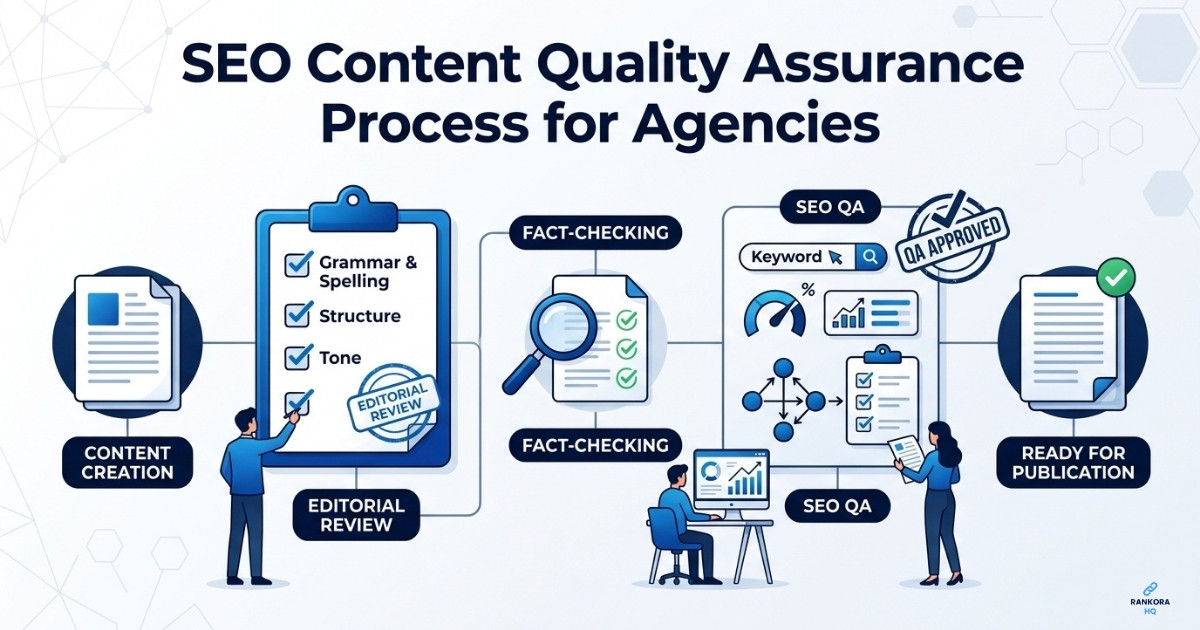
SEO content quality assurance is the final check that decides whether an article is accurate, useful, optimized, and ready for approval. In agency work, this step matters because one weak claim, broken link, wrong statistic, or missed search intent can create extra revisions and reduce client trust.
When I review content at Rankora HQ, I do not treat SEO content quality assurance as a simple grammar check. I look at the full article: facts, structure, originality, keyword use, links, sources, tone, and publishing readiness. This guide explains the content QA process agencies should follow before sending any article to a client or pushing it live.
What Is SEO Content Quality Assurance?
Simple Definition of SEO Content QA
SEO content QA means checking written content against a clear set of quality standards before it is approved or published.
For agencies, this usually includes an editor, SEO reviewer, or account manager checking whether the article meets the brief. The goal is simple: make sure the content is correct, helpful, and aligned with the client’s goals.
Why QA Is More Than Grammar Checking
Grammar is only one part of the review. A grammatically clean article can still fail if it answers the wrong question, uses weak sources, repeats competitor ideas, or includes unsupported claims.
In my experience, most serious content problems are not spelling mistakes. They are issues with accuracy, search intent, structure, links, and depth.
Where QA Fits in an Agency Content Workflow
Content QA should happen after the writer completes the draft and before the article goes to the client or publisher.
A simple agency workflow looks like this: writer self-check, editor review, SEO review, revision, final approval, then publishing. This keeps the process clear and reduces back-and-forth with clients.
Why Agencies Need a Content QA Process
Agencies need a content QA process because clients expect clean, accurate, and publish-ready work. Without a clear review system, small issues turn into repeated revisions, missed deadlines, and weaker client confidence.
A good QA process creates consistency. It helps every article meet the same standard before it leaves the agency.
It Protects Client Trust
Clients do not only judge the article. They judge the agency behind it.
If an article has wrong facts, poor formatting, weak links, or unclear writing, the client may question the whole workflow. A strong review process shows that the agency takes quality seriously before asking for approval.
It Reduces Revision Rounds
Most revision problems happen because content is sent too early.
When the draft is checked properly before delivery, the client receives a cleaner version. This saves time for the writer, editor, account manager, and client.
Accuracy and Fact-Checking Review
Accuracy is one of the most important parts of content QA. Before an article is approved, every factual claim should be checked for correctness, clarity, and source support.
This matters more in agency work because the content represents the client’s brand. A small factual mistake can make the whole article look careless.
Check Names, Dates, Numbers, and Statistics
Start with basic factual details. Check company names, product names, people’s names, locations, dates, percentages, prices, and statistics.
These are easy to get wrong, especially when writers use outdated sources or AI-assisted drafts. I always treat numbers and named entities as high-risk items during review.
Verify Claims Against Reliable Sources
Every important claim should be backed by a reliable source or clear internal knowledge from the client.
If the article says a strategy improves rankings, saves time, reduces costs, or follows a search engine guideline, the reviewer should check whether that statement is supported. Unsupported claims should be edited, sourced, or removed.
Remove Unsupported or Exaggerated Statements
SEO content should sound confident, but not careless.
Phrases like “guaranteed results,” “best in the world,” or “always works” can create trust problems. A good QA review softens exaggerated claims and replaces them with accurate, balanced wording.
Check Industry-Specific Terms and Examples
Agencies often write for technical or niche industries. That means terms, examples, and use cases must be reviewed carefully.
If the article is about legal, health, finance, SaaS, or SEO topics, the reviewer should check whether the language is accurate for that field. Correct terminology makes the content more trustworthy and useful.
Search Intent Review
Search intent review checks whether the article answers what the reader actually came to find. An article can be well-written and still fail if it does not match the reason behind the search.
For agency content, this step is important because the client is not paying for words. They are paying for content that fits a real search need.
Confirm the Article Answers the Main Query
The first check is simple: does the article answer the main keyword clearly?
If the keyword is “SEO content quality assurance,” the article should explain how content is reviewed before approval or publishing. It should not drift into broad SEO strategy, content promotion, or link-building campaign QA.
Check Whether Each Section Matches the Reader’s Goal
Every section should support the main topic.
If a section does not help the reader understand how to review SEO content, it should be shortened, moved, or removed. This keeps the article focused and easier to use.
Remove Sections That Do Not Help the Searcher
Some drafts include extra sections just to increase word count. That usually weakens the article.
During QA, I look for paragraphs that sound useful but do not answer the searcher’s real question. If they do not add clarity, process, or practical value, they should not stay.
Make Sure the Introduction Gives a Clear Promise
The introduction should quickly tell the reader what the article will cover.
A strong intro makes the promise clear: this article will explain the checks agencies should use before SEO content is approved or published. That promise should then be fulfilled in the rest of the article.
Originality and Depth Review
Originality review checks whether the article brings real value or only repeats what already exists in the SERP. For agencies, this step is important because clients do not want copied ideas in slightly different words.
A strong article should have its own angle, examples, structure, and useful explanation.
Check for Copied Structure or Rewritten Competitor Content
Some drafts follow competitor articles too closely. The words may be different, but the structure, examples, and points feel the same.
During QA, compare the draft with the brief and SERP notes. If the article looks like a rewritten version of another page, the structure should be changed and improved.
Remove Generic Filler and Repeated Ideas
Filler weakens content quality fast.
Lines like “quality content is important for success” do not help unless they explain something specific. A reviewer should remove repeated points, vague claims, and paragraphs that do not add practical value.
Add Practical Examples, Opinions, and Real Experience
Original content usually comes from experience.
For agency content, this can include client scenarios, workflow examples, review checklists, editorial notes, or lessons from past projects. These details make the article more useful and harder to copy.
Review AI-Assisted Content Carefully
AI-assisted drafts need extra review because they can sound polished but still be shallow, repetitive, or inaccurate.
The reviewer should check facts, tone, examples, and structure. AI can help with speed, but human review is what makes the content trustworthy and ready for approval.
SEO and On-Page Review
SEO review checks whether the article is properly optimized without making it sound forced. The goal is to help search engines understand the content while keeping the article useful for readers.
This step should happen after the main content is clear, accurate, and complete.
Check SEO Title, H1, Slug, and Meta Description
Start with the basic on-page elements.
The SEO title should include the main keyword and make the topic clear. The H1 should match the article angle. The slug should be short and readable. The meta description should explain the benefit in a simple way.
Review Heading Structure and Keyword Usage
Headings should follow a clear order and guide the reader through the topic.
During QA, check that the H2s and H3s support the main search intent. Also review whether the focus keyword and secondary keywords are used naturally in the article.
Make Sure Keywords Are Natural, Not Stuffed
Keyword stuffing makes content harder to read and weaker for trust.
If the same phrase appears too many times, replace some uses with natural variations. The article should sound like it was written for a person, not built around a keyword count.
Check Internal Links, Anchors, and Content Relevance
Internal links should point readers to useful related pages.
Review the anchor text, link placement, and destination page. Each link should feel natural in the sentence and support the topic. If a link looks forced or irrelevant, it should be removed or replaced.
Editorial Quality and Brand Voice Review
Editorial review checks whether the article is clear, readable, and aligned with the client’s voice. Good SEO content should not only rank; it should also sound professional and easy to trust.
This step turns a correct draft into a polished article.
Fix Grammar, Spelling, and Unclear Sentences
Start with basic writing issues.
Check grammar, spelling, punctuation, sentence structure, and awkward wording. If a sentence is hard to understand on the first read, rewrite it in a simpler way.
Improve Readability and Paragraph Flow
Readers should move through the article without confusion.
Use short paragraphs, clear headings, and smooth transitions. Each paragraph should connect naturally to the next point. If the article feels jumpy, the structure needs editing.
Match the Client’s Tone and Style Guide
Every client has a different voice.
Some brands want a formal tone. Others want a simple, direct, or friendly style. During QA, compare the draft with the client’s style guide, past content, and target audience.
Make the Article Sound Natural, Expert, and Human
The final article should sound like it was written by someone who understands the topic.
Remove robotic phrasing, empty statements, and overused SEO language. Add clear explanations and confident wording where needed. The goal is simple: useful content that feels real, trustworthy, and easy to read.
Evidence, Links, and Publishing Readiness
Evidence and link QA checks whether the article can be trusted and safely published. Before approval, the reviewer should confirm that important claims are supported, links work correctly, and the final draft is formatted properly.
This step helps prevent weak sourcing, broken links, and last-minute publishing mistakes.
Final Approval Workflow for Agencies
A clear approval workflow helps agencies avoid confusion before content is sent to the client or published. Everyone should know who reviews the draft, who requests changes, and who gives final approval.
This keeps the process simple and prevents missed checks.
Writer Self-Review
The writer should review the draft before sending it forward.
This first check should cover the brief, outline, facts, grammar, links, and basic SEO elements. A writer should never send a rough draft as a finished draft.
Editor Review
The editor checks clarity, structure, accuracy, originality, and readability.
This is where weak sections are improved, repeated ideas are removed, and the article is shaped into a cleaner final version.
SEO Review
The SEO reviewer checks whether the article matches the target keyword and search intent.
This includes the title, H1, headings, keyword use, internal links, metadata, and overall topical relevance.
Client or Account Manager Approval
Before publishing, the client or account manager should confirm that the article matches the brief and brand expectations.
This step is useful when the topic is technical, sensitive, or tied closely to the client’s product or service.
Final Publishing Check
The final check happens after all revisions are complete.
Review formatting, links, headings, CTA, author bio, metadata, and publishing notes. Once everything is correct, the article is ready to publish.
Check Whether Important Claims Have Sources
Not every sentence needs a source, but important claims should be supported.
Statistics, search engine guidance, industry data, and strong performance claims should link to reliable sources. If a claim cannot be supported, it should be rewritten or removed.
Review External Links for Authority and Relevance
External links should point to trusted sources, not random blogs or direct competitors.
For SEO content, good external sources may include Google documentation, industry studies, or well-known SEO publications. The source should support the exact point being made in the article.
Test Internal Links and Destination URLs
Internal links should be checked before the article is approved.
Make sure each link opens correctly and points to the right page. Also check that the anchor text matches the destination. A link about SEO content writing should not send the reader to an unrelated service page.
Confirm Formatting, CTA, Author Bio, and Final Publish Checklist
Before publishing, review the article as a finished page.
Check headings, spacing, bullet points, tables, images, metadata, CTA, author bio, and any required client notes. This final pass confirms that the article is not only written well, but also ready to go live.
Common SEO Content QA Mistakes to Avoid
Most content QA problems happen when agencies rush the final review. The draft may look complete, but important checks are missed because no one follows a clear process.
These are the mistakes I see most often in agency content workflows.
Only Checking Grammar
Grammar matters, but it is not the whole review.
An article can have perfect spelling and still miss the search intent, use weak sources, repeat generic points, or include incorrect claims. QA should cover the full content quality, not just surface-level editing.
Ignoring Search Intent
If the article does not answer the searcher’s real question, it will struggle to perform.
During QA, check whether the article matches the keyword, reader problem, and expected content type. If the reader wants a process, the article should not become a broad opinion piece.
Approving Unsupported Claims
Unsupported claims make content less trustworthy.
Statements about rankings, traffic, results, statistics, or industry trends should be checked carefully. If there is no source or real evidence, rewrite the claim in a more balanced way.
Overusing Keywords
Keyword use should feel natural.
Repeating the same phrase too often makes the content sound forced and outdated. A good reviewer should keep the focus keyword in the right places, then use natural variations where needed.
Publishing Without a Final Checklist
The final checklist is what catches small but costly mistakes.
Before publishing, check links, headings, metadata, formatting, CTA, author bio, and source accuracy. This final pass protects the agency from avoidable errors.
Frequently Asked Questions
What is SEO content quality assurance?
SEO content quality assurance is the process of checking content for accuracy, search intent, originality, SEO, links, style, and publishing readiness before approval.
What should be checked before publishing SEO content?
Before publishing, check facts, sources, headings, keyword usage, internal links, external links, metadata, formatting, CTA, and brand voice.
Who should review SEO content in an agency?
SEO content should usually be reviewed by the writer, editor, SEO specialist, and account manager or client before final approval.
How do agencies check content accuracy?
Agencies check names, dates, statistics, claims, examples, and sources to make sure the article is correct and trustworthy.
Is content QA the same as editing?
No. Editing focuses on improving the writing, while content QA checks the full article for accuracy, SEO, intent, links, evidence, and publish readiness.
Can AI tools help with SEO content QA?
Yes, AI tools can help spot grammar, structure, and clarity issues, but human review is still needed for accuracy, judgment, and brand fit.
Conclusion
SEO content quality assurance gives agencies a clear way to check content before it reaches the client or goes live. It helps catch weak claims, missed search intent, broken links, keyword issues, poor formatting, and unclear writing before they become bigger problems.
In my experience, the best agency content workflows are not complicated. They are consistent. When every article goes through accuracy checks, SEO review, editorial review, link QA, and final approval, the result is stronger content and fewer revision rounds. If your agency needs support with reliable, publish-ready content, Rankora HQ’s SEO content writing service can help you build a cleaner and more scalable content workflow.
Author Bio
Muhammad Awais is the founder of Rankora HQ, a white-label editorial content placement service based in Salalah, Oman. He helps SEO agencies and brands build topical authority through high-quality publishing partnerships on DR 40-90 editorial sites.