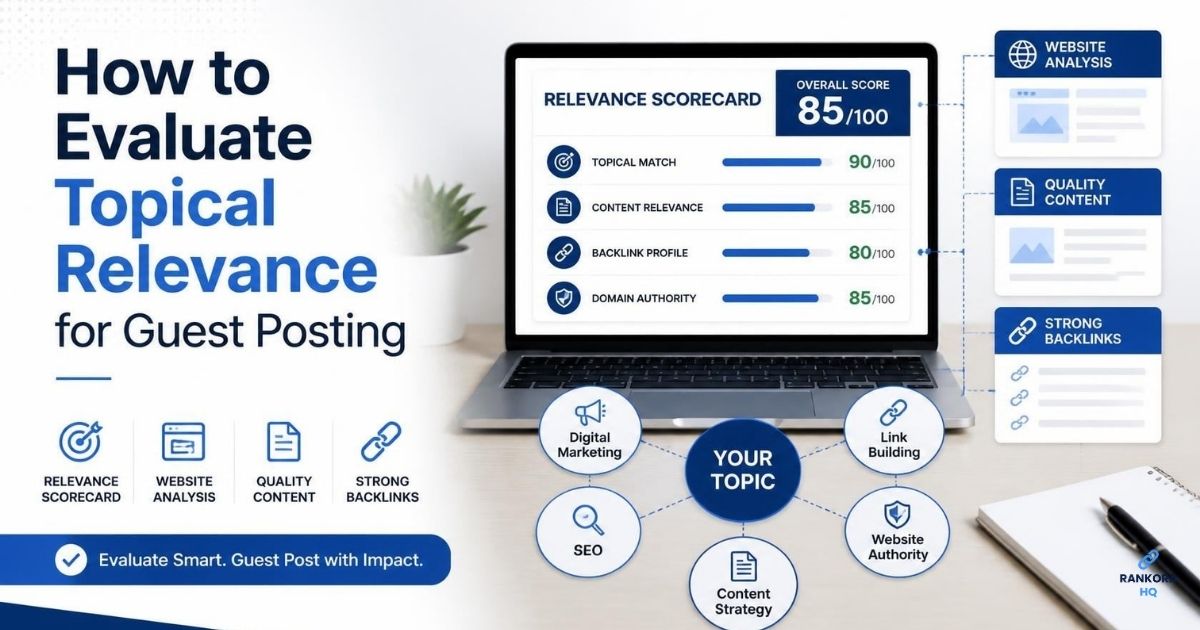
A website can have strong SEO metrics and still be a poor guest post opportunity if the topical fit is weak. In my experience, topical relevance guest posting is not about finding any high-DR publisher. It is about checking whether the site, category, article topic, audience, and target page all make sense together.
Before I approve a placement for a client, I look past surface-level numbers and ask one simple question: does this publisher genuinely belong in the same topic ecosystem? This guide breaks down how I evaluate topical relevance guest posting using a simple five-level relevance check and a practical scorecard you can apply before publishing.
Why Strong Metrics Are Not Enough for Guest Posting
Strong SEO metrics help, but they do not prove that a website is the right guest post placement. I have seen sites with high DR, clean traffic charts, and active publishing schedules still fail the most basic test: they were not relevant to the client’s business or target page.
That is where many guest posting campaigns go wrong. A placement can look good in a report, but if the publisher does not fit the topic, audience, or search intent, the link may add very little real value.
A High-DR Site Can Still Be the Wrong Placement
DR shows backlink strength. It does not show whether the site is a good editorial match.
For example, a SaaS company may look at a strong lifestyle website and think it is a good opportunity because the metrics look impressive. But if that website mostly covers home decor, fashion, food, and celebrity topics, the fit is weak.
The link may exist, but the context is off. That is not the kind of placement I would approve quickly.
The Real Risk of Publishing on Loosely Related Websites
The biggest risk is not just wasted budget. The bigger issue is building links that do not support the client’s topical footprint.
A guest post should help search engines and readers understand why the linked page belongs in that conversation. If the article feels forced onto the publisher, the relevance signal becomes weaker.
This is why I always check guest post relevance before looking at a site as “approved.”
What I Check Before Approving a Publisher for a Client
Before approving a publisher, I check five things:
- What the website mainly covers
- Which category the article will appear in
- Whether the article topic fits the site
- Whether the audience matches the client’s market
- Whether the target page fits the article context
If those signals do not line up, strong metrics alone are not enough. A relevant, well-matched publisher will almost always be a better choice than a stronger-looking site with poor editorial fit.
What Topical Relevance Means in Guest Posting
Topical relevance in guest posting means the publisher, article topic, audience, and linked page all make sense together. The guest post should feel like it naturally belongs on that website.
When I review a publisher, I do not only ask, “Can we get a link here?” I ask, “Would this article make sense for this site’s readers?” If the answer is weak, the placement is usually weak too.
Simple Definition of Topical Relevance for Guest Posting
In simple terms, topical relevance means the guest post is placed on a website that covers related subjects.
For example, a B2B SaaS article fits better on a marketing, business, sales, or software publication than on a general entertainment site. The topic, audience, and link context should all connect.
That connection is what makes the placement feel editorial instead of random.
Topical Relevance vs Topical Authority
Topical relevance is about the fit of a specific placement. Topical authority is about how strongly a website or brand is known for a topic over time.
They are connected, but they are not the same thing.
When to Link to the Full Topical Authority Guide
The topical authority guide should be linked only when the reader needs a deeper explanation of authority-building.
A good internal link could look like this:
Learn how editorial placements support long-term topical authority in our guide to topical authority and editorial content placement.
That keeps this article focused. Here, the goal is not to explain topical authority from the beginning. The goal is to help you decide whether a guest post site is relevant enough before you approve it.
The Five Levels of Guest Post Relevance
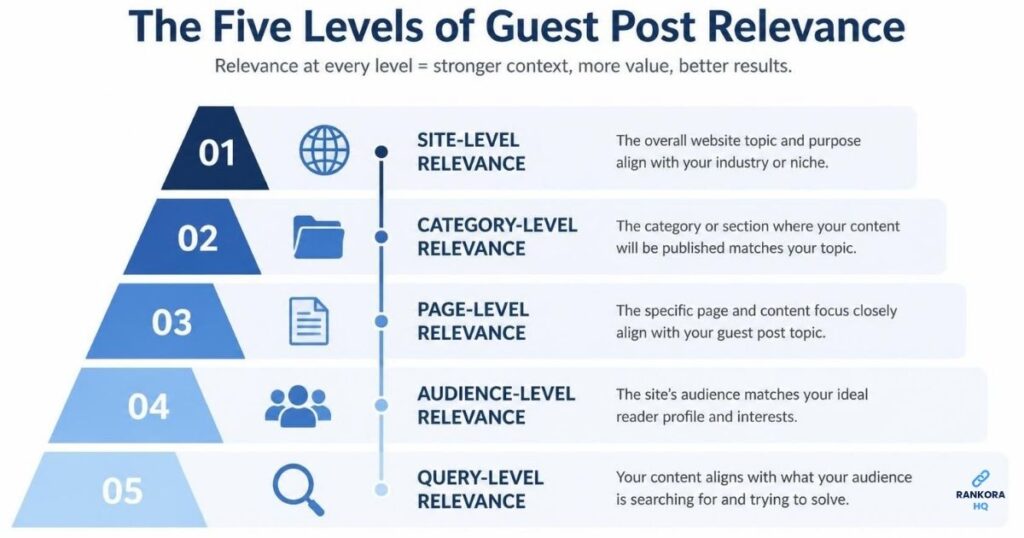
Guest post relevance should be checked at more than one level. A site can look relevant on the surface, but the actual article or category may still be a poor fit.
When I review relevant guest post sites, I usually break relevance into five simple layers: site, category, article, audience, and query intent.
Site-Level Relevance: What the Whole Website Is About
Site-level relevance means checking what the publisher mainly covers.
If the website regularly publishes about SaaS, marketing, business growth, or technology, it may be a strong fit for a software client. But if the same site mostly covers lifestyle, travel, entertainment, and random product lists, the fit becomes weaker.
This is the first step in judging publisher topical relevance.
Category-Level Relevance: Where the Article Will Live
Category-level relevance looks at the section where your guest post will be published.
A broad news site can still work if the article appears in the right category. For example, a personal finance brand may fit well in a finance, money, or business section.
But if that same article is placed under sports, fashion, or general lifestyle, the editorial fit becomes questionable.
Page-Level Relevance: Whether the Article Topic Fits
Page-level relevance is about the actual guest post topic.
The article should make sense for the publisher and create a natural reason to link to the target page. If the article feels forced just to include a backlink, the placement is weak.
Good guest post relevance means the topic, link, and publisher all support each other.
Audience-Level Relevance: Who Actually Reads the Publisher
Audience-level relevance checks whether the publisher’s readers match the client’s target market.
A site may cover a related topic, but the audience may still be wrong. For example, a beginner lifestyle blog may not be ideal for an enterprise SaaS client, even if it accepts business content.
The question is simple: would this publisher’s readers care about the client’s offer?
Query-Level Relevance: Whether the Search Intent Connects
Query-level relevance looks at the connection between the article topic and the target page’s search intent.
If the guest post discusses “CRM software for agencies,” linking to a CRM feature page makes sense. But linking that same article to an unrelated homepage or product page may feel weak.
This is where niche relevance becomes practical. The article and target page should belong to the same topic ecosystem, not just the same broad industry.
Topical Relevance Guest Posting Scorecard
A simple scorecard makes topical relevance easier to judge before you approve a publisher. Instead of guessing, I like to score each placement across five practical signals.
This is not a perfect formula. It is a quick decision-making tool to help you separate strong placements from risky ones.
| Relevance Signal | Score |
| Site topic alignment | 0–2 |
| Category alignment | 0–2 |
| Article topic alignment | 0–2 |
| Audience overlap | 0–2 |
| Target-page context fit | 0–2 |
| Total | 10 |
How the 10-Point Scoring Model Works
Each signal gets a score from 0 to 2.
A score of 0 means the fit is weak. A score of 1 means the fit is partial. A score of 2 means the fit is strong and natural.
Site Topic Alignment: 0–2 Points
This checks whether the whole website covers topics related to the client’s industry.
A software company should usually appear on websites that cover SaaS, business, marketing, technology, or operations. If the publisher mostly covers entertainment, fashion, or mixed lifestyle content, the score should be lower.
Good publisher topical relevance starts at the site level.
Category Alignment: 0–2 Points
This checks whether the article will be published in the right section of the website.
A broad publication can still be useful if the article appears in a relevant category.
Article Topic Alignment: 0–2 Points
This checks whether the guest post topic fits both the publisher and the client.
The article should feel natural on the website. It should not look like a random topic created only to place a link.
Audience Overlap: 0–2 Points
This checks whether the publisher’s readers are likely to care about the client’s product, service, or topic.
For example, an agency-focused SEO article makes sense on a marketing publication. It makes less sense on a general lifestyle blog.
The stronger the audience overlap, the stronger the placement.
Target-Page Context Fit: 0–2 Points
This checks whether the article gives a natural reason to link to the target page.
If the guest post discusses link building for agencies, linking to a white-label guest posting service page makes sense. But linking that same article to an unrelated service page would feel forced.
This is where niche relevance and search intent need to work together.
How to Interpret the Final Score
Use the total score as a simple approval guide:
| Total Score | Meaning |
| 8–10 | Strong fit |
| 5–7 | Review carefully |
| 0–4 | Usually reject |
If a publisher scores 8 or higher, it is usually worth considering. If it lands between 5 and 7, I would review the article angle and category more carefully. If it scores below 5, I usually reject it unless there is a very strong strategic reason to continue.
Practical Examples of Good and Bad Relevance
Topical relevance becomes easier to judge when you compare real placement scenarios. A site may look useful at first, but the fit can change once you check the category, topic, audience, and target page.
Here are a few simple examples I use when reviewing relevant guest post sites for clients.
SaaS Company on a Marketing or Business Publisher
A SaaS company can be a strong fit for a marketing, business, sales, or software publisher.
For example, if the article is about improving agency workflows and links to a project management software page, the connection feels natural. The publisher’s audience already cares about tools, systems, and business growth.
This would usually score well for guest post relevance.
Personal Finance Brand on a Finance Category
A personal finance brand can work well on a broad news website if the article appears in the finance, money, or business category.
For example, an article about budgeting apps linking to a personal finance tool makes sense. The topic, category, and audience are connected.
This is a good example of strong category-level relevance even on a broad publisher.
Personal Finance Brand Inside an Unrelated Sports Article
A personal finance brand linked from an unrelated sports article is usually a poor fit.
Even if the website has authority, the article context does not support the link. A reader looking for sports news is not expecting a link to a finance product or budgeting guide.
That is weak page-level relevance, and I would normally reject that placement unless the article angle clearly connects sports and finance in a natural way.
How to Check Publisher Topical Relevance Before Approval
The best way to check publisher topical relevance is to review the website before the guest post is written or published. I never rely only on a publisher list, DR score, or traffic number.
A quick manual review can show whether the site is a real fit or just a metric-based opportunity.
Review the Homepage and Main Navigation
Start with the homepage and main menu.
These areas usually show what the website is really about. If the main navigation covers business, marketing, SaaS, SEO, or technology, it may be relevant for a B2B client.
If the navigation is mostly lifestyle, fashion, travel, or entertainment, the fit may be weaker.
Check Recent Published Articles
Next, review the latest articles.
A publisher may claim to cover a niche, but the recent content tells the real story. Look at the last 10 to 20 posts and check whether they follow a clear topic pattern.
If the site publishes random topics every day, the topical signal is usually weak.
Inspect the Category Where the Guest Post Will Appear
Do not only check the website. Check the exact category too.
A broad publication can still be useful if your article appears in the right section. For example, a finance article in a money category makes sense.
But the same article placed in an unrelated category may reduce the editorial fit.
Compare the Publisher Audience With the Client’s Buyer
A relevant site should attract readers who may care about the client’s topic.
For example, an SEO agency service fits better on a marketing or business publication than on a general lifestyle blog. The audience should understand the problem your article discusses.
If the reader would not care, the placement is not strong.
Match the Article Idea to the Target Page Intent
Finally, compare the guest post topic with the target page.
The article should create a natural reason to link to that page. If the target page is about white-label guest posting, the article should discuss agency link building, content placement, or SEO outsourcing.
That is how I judge whether the placement has real topical relevance before approval.
Common Relevance Mistakes to Avoid
Most guest posting mistakes happen when people approve a site too quickly. They look at DR, traffic, or price, but they do not check whether the placement actually makes sense.
If the relevance is weak, the guest post may look good on paper but offer little real value.
Choosing Sites Only Because DR Looks Strong
A high DR score does not automatically mean a strong placement.
DR can show backlink strength, but it does not show whether the publisher is relevant to your client’s topic. A lower-DR site with strong niche relevance can often be a better choice than a high-DR site with no clear connection.
Metrics should support the decision, not replace it.
Confusing Broad Category Match With Real Editorial Fit
A broad category match is not always enough.
For example, a “business” category can include anything from startups to real estate, finance, HR, software, and leadership. That does not mean every business article is a good fit for every business client.
You still need to check the article angle, audience, and target page context.
Publishing Content That Feels Forced on the Website
A guest post should feel like it belongs on the publisher’s site.
If the topic looks random, the link will also feel random. This often happens when someone builds an article around a backlink instead of building it around a useful topic.
Good editorial fit means the article would still make sense even without the link.
Ignoring Audience Mismatch
Audience mismatch is easy to miss.
A website may cover a related topic, but its readers may not match the client’s buyers. For example, a beginner blog may not be ideal for an enterprise software brand.
Before approving the site, ask: would this audience care about the problem this article solves?
Linking to a Target Page That Does Not Match the Article Context
The target page must fit naturally inside the guest post.
If the article discusses agency link building, linking to a guest posting or link building service page makes sense. But linking to an unrelated page weakens the placement.
The article topic and target page should support the same search intent or topic ecosystem.
How Rankora HQ Applies Relevance Checks for Agencies
At Rankora HQ, I check topical relevance before sending publishers for approval. This helps agencies avoid placements that look strong in metrics but weak in actual context.
For me, a good guest post opportunity should match the client’s niche, article angle, audience, and target page. If that fit is missing, I do not treat it as a strong placement.
Why I Review Publishers Before Anything Goes Live
I review publishers before publishing because agencies need control over quality.
A site may have strong DR, but that does not mean it is the right fit for the client. I check the website topic, recent content, category, and article context before moving forward.
This keeps the process cleaner and reduces the risk of irrelevant placements.
How Approval Protects Agency-Client Trust
Agency clients expect clear reasoning behind every link.
When a publisher is reviewed before publishing, the agency can approve the site with more confidence. They are not just seeing a domain metric. They are seeing why the placement makes sense.
That is why client approval is built into our white-label guest posting service.
Where Relevance Fits Inside White-Label Guest Posting Reports
Relevance should also be visible after the placement goes live.
In a white-label report, agencies should be able to show the live URL, publisher details, anchor text, target page, and placement context. This makes the link easier to explain to the client.
A strong report does not just prove that a link was built. It shows that the placement was chosen with purpose.
Frequently Asked Questions
What is topical relevance in guest posting?
Topical relevance in guest posting means the publisher, article topic, audience, and target page all fit naturally together.
How do I know if a guest post site is relevant?
Check the website’s main topic, category, recent articles, audience, and whether your target page fits the article context.
Is DR more important than topical relevance?
No. DR is useful, but topical relevance matters more when you want the link to make real contextual sense.
Can a broad news site still be relevant?
Yes, if your article appears in the right category and the topic matches your client’s industry or audience.
What score should a publisher get before approval?
A score of 8–10 is usually a strong fit, 5–7 needs careful review, and 0–4 is usually not worth approving.
Should I reject every site outside my exact niche?
Not always. A site can still work if the category, article topic, audience, and target-page context are closely connected.
Why does audience relevance matter in guest posting?
Audience relevance matters because the publisher’s readers should care about the topic, problem, or solution mentioned in the guest post.
Conclusion
Topical relevance should be checked before you approve any guest post placement. Strong metrics can help, but they do not replace real editorial fit, audience match, and target-page context.
In my experience, the best placements usually pass all five relevance levels: site, category, article, audience, and query intent. Use the scorecard before publishing, and you will avoid many weak guest post opportunities that only look good on paper.
If your agency wants a cleaner way to review and approve relevant placements, Rankora HQ can help with white-label guest posting services built around transparency, editorial quality, and client approval.
Author Bio
Author: Muhammad Awais
Title: Founder, Rankora HQ
Muhammad Awais is the founder of Rankora HQ, a white-label editorial content placement service based in Salalah, Oman. He helps SEO agencies and brands build topical authority through high-quality publishing partnerships on DR 40-90 editorial sites.
LinkedIn: linkedin.com/in/muhammad-awais-seo-outreach