
If you run SEO campaigns for clients, you need to know what is guest posting in SEO before you treat it as another link-building task. Guest posting is the process of publishing useful content on a relevant third-party website as a guest author or contributor. In SEO, the goal is not only to earn a backlink. The real goal is to place helpful editorial content in front of the right audience, build authority, and support a wider off-page SEO strategy.
In my experience working with agencies, most guest posting problems start when people chase links before understanding the editorial process. This guide explains what is guest posting in SEO, how guest posting works, why agencies use it, what a legitimate guest post looks like, and what it can realistically achieve for client campaigns.
What Is Guest Posting in SEO?
Guest posting in SEO is the practice of publishing useful content on another website to reach a relevant audience and earn editorial visibility. The content is written by a guest author or contributor, then published on a third-party site that accepts outside expertise.
A guest post usually includes the author’s ideas, examples, and sometimes a contextual link back to the author’s website or client website. That link is not the whole purpose, though. A strong guest post should also educate readers, support brand visibility, and fit naturally into the publisher’s content.
Simple Definition of Guest Posting
Guest posting means writing an article for another website instead of publishing it on your own site. In SEO, it is often used to build authority, earn relevant backlinks, and place a brand in front of a new audience.
For agencies, the process matters as much as the final link. A proper guest post includes publisher research, topic planning, content writing, editorial review, approval, publishing, and reporting.
Guest Posting vs Guest Blogging
Guest posting and guest blogging are often used to mean the same thing. Both involve contributing content to another website as an outside author.
The small difference is how people use the terms. “Guest blogging” often sounds more content-focused, while “guest posting” is commonly used in SEO and link-building conversations. For agencies, both terms usually point to the same workflow: create helpful contributor content, publish it on a relevant website, and use it to support off-page SEO.
How Guest Posting Works
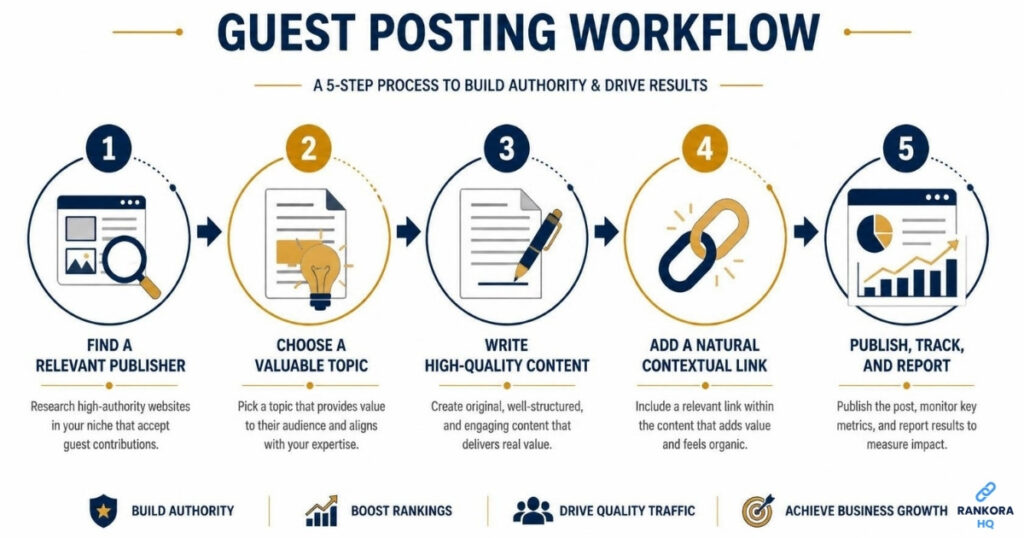
Guest posting works through a simple editorial process: find the right publisher, choose a useful topic, write valuable content, place links naturally, and report the final publication. For agencies, this process needs control at every step because clients expect quality, relevance, and proof.
A good guest post is not created by sending random articles to random websites. It works best when the publisher, topic, content, and link all make sense together.
Step 1: Choose the Right Publisher
The publisher should match the client’s niche, audience, or market. A SaaS brand should not be placed on a random lifestyle blog just because the site has a high DR.
We usually check three things first: topical relevance, real organic traffic, and editorial quality. If the website looks thin, outdated, or filled with unrelated posts, it is not a strong option.
Step 2: Pick a Useful Topic
The topic should serve the publisher’s readers first. Editors are more likely to approve content when the idea fits their existing audience and adds something useful.
For SEO, the topic should also connect naturally to the client’s target page. This makes the link easier to place without forcing it.
Step 3: Write Contributor Content
Contributor content should feel like a real article, not a sales pitch. It needs a clear structure, helpful examples, simple explanations, and original insight.
Strong guest posting SEO depends on quality writing. Poor content may get published on weak sites, but it rarely builds trust or long-term value.
Step 4: Add Editorial Links Naturally
A guest post backlink should support the reader. It should point to a relevant page that adds more context to the topic.
The anchor text also matters. Natural anchors usually work better than forced exact-match anchors because they look more editorial and fit the sentence better.
Step 5: Publish and Report
After approval, the article goes live on the publisher’s website. At this stage, agencies need clear reporting for the client.
A proper report should include the live URL, publisher details, anchor text, target page, and publication status. This keeps the process transparent and easy to review.
What a Good Guest Post Looks Like
A good guest post looks like a real editorial article that fits the publisher, helps the reader, and includes links only where they make sense. It should not feel like an advert or a thin article written only to place a backlink.
For agencies, quality control matters because every published post reflects on the client’s brand. A weak guest post may still go live, but it rarely creates trust.
Relevant Website
The website should match the client’s niche, service, audience, or market. Relevance is one of the first signs that the placement makes sense.
For example, a cybersecurity company fits better on a tech, SaaS, or business security website than on a general lifestyle blog. The closer the publisher is to the client’s topic, the more natural the guest post feels.
Useful Article Topic
The topic should answer a real question for the publisher’s readers. Editors usually want content that adds value to their site, not content that only serves the guest author.
A strong topic connects three things: the publisher’s audience, the client’s expertise, and the SEO goal. When those three match, the article becomes easier to approve and easier to read.
Natural Link Placement
A guest post link should fit the sentence and support the point being made. It should help readers find more context, not distract them.
I avoid forcing links into paragraphs where they do not belong. A natural editorial link usually sits inside a relevant explanation, example, statistic, or resource mention.
Clear Quality Standards
A good guest post should be original, well-structured, and easy to read. It should follow the publisher’s guidelines for formatting, tone, word count, and link rules.
Before sending content for approval, agencies should check grammar, originality, topic fit, anchor text, and the target URL. Small quality checks prevent bigger problems after publication.
Guest Posting Benefits and Limits
Guest posting can support SEO, brand visibility, and referral traffic, but it should not be treated as a shortcut to instant rankings. It works best when the publisher is relevant, the content is useful, and the link fits naturally.
Agencies should explain guest posting honestly to clients. It is a strong off-page SEO method, but it is not magic. Results depend on quality, consistency, competition, and the client’s overall SEO health.
Main Benefits
The biggest benefit of guest posting is earning relevant editorial links from third-party websites. These links can support authority when they come from real publishers with useful content and real audiences.
Guest posting can also increase brand visibility. A client’s name, website, or expertise appears outside their own platform, which helps build recognition over time.
Another benefit is referral traffic. A well-placed guest post can send interested readers to the client’s website, especially when the topic matches what the audience already wants to learn.
Realistic Limits
Guest posting does not guarantee first-page rankings. One published article will not fix weak content, poor technical SEO, or a website with no clear topical structure.
It also does not guarantee leads. A guest post may build awareness and send traffic, but conversions depend on the client’s offer, landing page, trust signals, and follow-up process.
I always prefer setting realistic expectations early. Guest posting supports SEO growth, but it works best as part of a wider strategy.
Quality Beats Volume
A few strong editorial guest posts are usually better than many weak placements. Quality means relevant publishers, useful content, natural links, and clean reporting.
Low-quality volume can create problems. If an agency publishes too many unrelated guest posts on poor websites, the campaign may look unnatural and deliver little value.
For client work, I would rather build fewer placements that make sense than chase a large number that only looks good in a spreadsheet.
Common Guest Posting Mistakes
The most common guest posting mistakes happen when agencies focus on getting a link instead of building a relevant editorial placement. A guest post should support SEO, but it should still look and read like a useful article.
Most problems can be avoided with better publisher checks, cleaner content, natural anchors, and clear approval before publishing.
Choosing Sites Only by DR
DR can help you compare website authority, but it should never be the only filter. A high-DR website can still be irrelevant, low-quality, or filled with unrelated guest posts.
I always look at topical relevance, organic traffic, content quality, and outbound link patterns. A lower-DR site in the right niche can sometimes be more useful than a broad high-DR site with no real connection.
Using Poor-Quality Content
Thin content is one of the fastest ways to weaken a guest post. If the article only repeats basic points and adds no real value, readers and editors can spot it quickly.
Good contributor content should answer a clear question, explain the topic simply, and give the publisher a reason to accept it.
Forcing Exact-Match Anchors
Exact-match anchors can look unnatural when they are forced into a sentence. Editors may reject them, and readers may notice that the link feels out of place.
A better approach is to use natural anchor text that fits the paragraph. The link should support the article, not control it.
Ignoring Publisher Guidelines
Every serious publisher has rules for topics, formatting, links, tone, word count, and author details. Ignoring these rules usually creates delays or rejection.
Agencies should review guidelines before writing. It saves time and makes the content easier for editors to approve.
Treating Guest Posting as a One-Time Task
Guest posting works better as a steady SEO activity, not a one-time order. One article may help, but it rarely changes a full campaign by itself.
Agencies should connect guest posting with content strategy, anchor planning, topical authority, and reporting. That is how it becomes part of a real SEO workflow.
How Agencies Should Approach Guest Posting
Agencies should approach guest posting as an editorial SEO process, not a quick link order. The goal is to build placements that make sense for the client, the publisher, and the reader.
A strong agency workflow keeps everything clear before anything goes live. That includes the website, topic, content, anchor text, target URL, and final report.
Start With the Client’s SEO Goal
Before choosing publishers, agencies should define the real goal. Is the client trying to support rankings, build authority, increase visibility, or promote a specific page?
This matters because not every guest post should serve the same purpose. A homepage link, service page link, and blog post link may need different topics and publishers.
Build Around Topical Relevance
Topical relevance should guide the whole guest post strategy. The publisher, article topic, anchor text, and target page should all connect naturally.
For example, if the client sells project management software, the guest post should appear on a business, SaaS, productivity, or management-related website. That connection makes the placement easier to trust.
Keep Approval Before Publishing
Clients should know what is being published before it goes live. This includes the publisher, topic, content angle, anchor text, and target page.
In my workflow, approval protects both sides. The agency avoids surprises, and the client feels in control of the campaign.
Track Every Placement Clearly
Every guest post should be tracked after publication. A simple report should include the live URL, publisher name, anchor text, target page, publication date, and key site metrics.
Clear reporting helps agencies show the value of the work. It also makes future planning easier because everyone can see what has already been published.
Guest Posting and Google Link Compliance
Guest posting is safest when the content is useful first and the link is placed naturally, transparently, and without trying to manipulate search rankings.
Google does not discourage useful contributor or guest articles that educate readers. However, large-scale article campaigns created mainly to build ranking links may violate Google’s spam policies. The problem starts when guest posts are created mainly to pass ranking credit through artificial links. Google’s spam policies define link spam as links created primarily to manipulate rankings, including optimized anchor text links in guest posts, advertorials, or distributed articles.
That is why I look at guest posting through two filters: editorial value and link compliance. If the article would not be useful without the backlink, it is probably not strong enough.
Paid Guest Posts vs Organic Contributions
A paid guest post usually involves money, placement fees, sponsored publishing, or commercial exchange.
An organic contribution is different. It is accepted because the article gives the publisher something valuable for its audience. That value may be expert insight, original experience, a useful framework, or a clear answer to a problem their readers have.
The risk is not only whether money changed hands. The real question is this: was the post published mainly to influence rankings?
If the answer is yes, the link needs extra care.
Google recommends marking advertisements and paid placements with rel=”sponsored”. The nofollow attribute is also acceptable, although sponsored is preferred., but those links must be qualified with rel=”nofollow” or rel=”sponsored” when they are paid or commercial in nature.
For agency campaigns, I keep this distinction clear:
- Organic editorial contribution: content accepted because it helps the audience
- Sponsored placement: content or link included as part of a paid arrangement
- Manipulative guest post: content created mainly to pass ranking signals
The first can be a strong brand and authority play. The second needs proper link qualification. The third should be avoided.
At Rankora HQ, I prefer editorial placements where the article stands on its own. A backlink should support the article, not be the whole reason the article exists.
Standard, Nofollow, Sponsored, and UGC Links
Standard, Nofollow, Sponsored, and UGC Links tell search engines different things about the relationship between pages.
A normal link can pass ranking signals. A nofollow link tells Google not to treat that link as a standard endorsement. A sponsored link identifies a link created as part of advertising, sponsorship, or another paid arrangement. Google specifically recommends marking paid placements with rel=”sponsored”.
Here is the simple version:
- Standard link: Used when the link is natural and editorially earned
- Nofollow link: Used when the publisher does not want to pass endorsement
- Sponsored link: Used for paid, sponsored, or commercial placements
- UGC link: Used for user-generated content such as comments or forum posts
Some clients ask only for dofollow links. I understand why. They want SEO value.
But in real campaigns, forcing every placement to be dofollow can create risk. A natural backlink profile usually includes a mix of link types. Not every good placement needs to pass PageRank to have value.
A nofollow link from a strong, relevant publication can still bring referral traffic, brand exposure, and trust. It can also support a broader authority strategy.
Choosing Natural Anchor Text
Natural anchor text matches the context of the sentence and does not look forced.
This is one of the biggest areas where guest posting goes wrong. A good article can become risky when the anchor text is too commercial, too exact-match, or repeated across too many placements.
For example, if every guest post links with the exact anchor “best guest posting service,” that pattern looks unnatural. It also reads badly for users.
Better anchor text options include:
- Brand anchors
- URL anchors
- Partial-match anchors
- Natural phrase anchors
- Contextual anchors
- Long-tail descriptive anchors
For example:
- “Brand Name”
- “our guest posting workflow”
- “editorial content placement service”
- “this link building process”
- “agency-focused guest posting support”
The anchor should fit the sentence first. SEO comes second.
When we manage a guest posting service for agencies, We review anchor text before publication because one bad anchor can weaken an otherwise good placement.
Avoiding Manipulative Link Practices
Manipulative link practices create short-term movement and long-term risk.
Google has clearly warned against low-quality sponsored and guest post campaigns created mainly for links, especially when links are not properly tagged. Google has also said excessive sponsored or guest posting without proper link tags may lead to algorithmic or manual actions.
Avoid tactics like:
- Publishing on irrelevant websites only because they have high DR
- Using exact-match anchors repeatedly
- Placing links in thin or generic articles
- Buying bulk guest posts from low-quality networks
- Hiding commercial relationships
- Publishing spun or AI-mass-produced content
- Linking to money pages where the context feels forced
- Ignoring publisher guidelines
- Using guest posts only for ranking manipulation
A safer approach is simple: choose relevant publishers, write useful content, use natural anchors, and be honest about commercial placements.
I also avoid placements where the site publishes every topic under the sun. A website about tech, pets, casinos, crypto, home improvement, and health on the same blog is usually a red flag.
Topical relevance matters more than a shiny metric.
Keeping Guest Posts Useful for Readers
A guest post should help the reader even if the link were removed.
That is the standard I use before approving content.
Useful guest posts usually include:
- Clear answers
- Practical examples
- Original experience
- Specific advice
- Relevant internal and external references
- A natural reason for every link
- A structure that matches the publisher’s audience
If the article feels like filler wrapped around a backlink, it is not good enough.
This is also why content quality matters in link building. You cannot separate the link from the page that carries it. A strong placement needs a strong article, a relevant publisher, and a clean editorial reason for the link to exist.
For agencies that do not have time to write every article internally, our SEO content writing service for agencies helps create guest post content that feels useful, not forced.
Guest posting still works when it is done with editorial discipline. It becomes risky when people treat publishers like link slots instead of real websites with real readers.
How to Measure Guest Posting Results
Guest posting results should be measured by publication quality, link status, indexing, referral traffic, ranking signals, and the long-term value of the placement.
A guest post is not “done” when the article goes live. That is only the first checkpoint. The real work is making sure the placement is live, indexed, accessible, relevant, and still valuable after publication.
When I report placements for agency clients, I do not only send a URL and call it complete. I check the page, the link, the anchor text, the publisher quality, and the early performance signals.
Confirm Publication and Indexing
The first step is to confirm that the guest post is published correctly.
Check the live article and make sure:
- The page is accessible
- The title and content are correct
- The backlink is included
- The anchor text is correct
- The link points to the right URL
- The author bio is correct, if included
- The page is not blocked by noindex
- The article is visible on the publisher’s site
After that, check whether the page is indexed.
You can use a simple Google search like:
As a quick public check, search Google for the exact published URL. For detailed indexing information, the publisher must inspect the URL inside its own verified Search Console property.
You can also inspect the URL through Google Search Console. Search Console’s URL Inspection tool only works when the inspected URL belongs to the currently selected verified property—not simply because you control the website receiving the backlink.
Indexing can take time. A page may not appear in Google immediately after publication. That is why we usually check indexing soon after publication, then again after a few days.
A guest post that never gets indexed may still exist, but its SEO value is limited. For SEO campaigns, indexing matters.
Monitor Link and Page Status
Guest post links can change after publication.
An editor may update the article, remove a link, change the anchor, add a nofollow tag, or redirect the page. Sometimes the article stays live, but the link disappears.
That is why link monitoring is important.
Track these details:
- Live article URL
- Target URL
- Anchor text
- Link type
- Dofollow or nofollow status
- Sponsored or nofollow attributes
- Page index status
- Page response code
- Publication date
- Last checked date
I also check whether the page still returns a normal 200 status code. If the article redirects, breaks, or returns a 404 error, the placement needs review.
For agencies, this is especially important because clients expect link stability. A placement report should not only show what went live. It should also make it easy to recheck the link later.
Measure Referral Traffic
Referral traffic shows whether people are clicking from the guest post to your site.
Not every guest post will send a lot of traffic. That is normal. Some placements are more valuable for authority and relevance than direct visits.
Still, referral traffic is useful because it shows real user activity.
In Google Analytics, check:
- Referral source
- Sessions from the publisher domain
- Engaged sessions
- Time on site
- Conversions
- Assisted conversions
- Landing page performance
For example, a guest post from a smaller but highly relevant industry blog may send fewer visitors than a large general website. But those visitors may spend more time on the page or convert better.
That is why I do not judge placements only by traffic volume. I look at traffic quality.
A relevant placement with 20 qualified visits can be more useful than a broad placement with 500 uninterested clicks.
Track Visibility and Ranking Signals
Guest posting results often appear gradually, not overnight.
A single guest post may not move rankings by itself. But a consistent pattern of relevant, editorial links can support stronger visibility over time.
Track signals like:
- Keyword position changes
- Landing page impressions
- Organic clicks
- Referring domains
- Topical relevance of new links
- Growth in branded searches
- Movement of target pages
- Page-level authority improvement
- Search Console performance trends
Do not look at rankings too early. Search engines need time to crawl, process, and evaluate new links.
I usually compare performance before and after publication, but I avoid making unrealistic promises. A guest post is one signal inside a larger SEO system. Content quality, site authority, technical health, internal links, and competition all affect results.
This is why link building should support a real SEO strategy, not replace one.
Report Results to Clients
Client reporting should be clear, simple, and transparent.
For agency campaigns, the client should be able to understand exactly what was published, where it was published, and what value the placement provides.
A strong guest post report should include:
- Publisher name
- Publisher URL
- Live article URL
- Target URL
- Anchor text
- Link type
- DR or authority metric
- Estimated organic traffic
- Niche/category
- Publication date
- Indexing status
- Notes about placement quality
This is where white-label reporting matters. Agencies often need to show the result under their own brand, not the provider’s brand.
At Rankora HQ, the goal is to make this process simple. After the placement goes live, the agency should receive a clean white-label SEO report they can share with their client without extra editing.
Good reporting builds trust. It also reduces back-and-forth because all key details are already documented.
Review Placements After 30, 60, and 90 Days
Guest posting should be reviewed after 30, 60, and 90 days because SEO impact takes time.
The first report confirms publication. The later reviews show whether the placement stayed live and whether the target page gained any visibility signals.
A simple review schedule works well:
After 30 days:
- Check if the article is still live
- Confirm link and anchor text
- Check indexing status
- Review early referral traffic
- Note any immediate ranking movement
After 60 days:
- Compare Search Console trends
- Check target keyword movement
- Review organic impressions
- Confirm the link is still active
- Look for early authority signals
After 90 days:
- Review ranking direction
- Measure referral traffic quality
- Compare page performance before and after
- Decide whether more links are needed
- Identify which publisher types performed best
This 30/60/90-day review helps agencies improve future campaigns. Over time, you start seeing which niches, publishers, anchors, and page types produce the best results.
That is the real value of measurement. It does not only prove what happened. It helps you build smarter campaigns next time.
Guest Posting vs Related Strategies
Guest posting, sponsored posts, niche edits, and digital PR can all support visibility and authority, but they work differently. The right option depends on the campaign goal, required control, available time, and type of placement.
| Strategy | How It Works | Best For | Level of Control | Typical Speed | Main Limitation |
| Guest Posting | A new article is written and published on a relevant third-party website. | Topical relevance, contextual links, brand authority, and repeatable agency campaigns. | High control over the topic, content angle, and link context. | Moderate | Requires publisher research, outreach, writing, approval, and editorial review. |
| Sponsored Posts | A publisher is paid to publish branded, promotional, or sponsored content. | Paid brand exposure, product promotion, and visibility on a specific publication. | Usually high, depending on the publisher’s rules. | Moderate to fast | Commercial links may require appropriate sponsored or nofollow qualification. |
| Niche Edits | A contextual link is added to an existing relevant article. | Faster placements and links from established, already-published pages. | Lower control because the article and topic already exist. | Usually faster | The link can appear unnatural when the existing content is not closely relevant. |
| Digital PR | Brands earn media mentions through original data, expert commentary, news, reports, or campaigns. | High-authority coverage, brand awareness, media mentions, and newsworthy campaigns. | Low control over publication, wording, and link inclusion. | Unpredictable | Results are less consistent, and outreach may not produce coverage. |
Guest posting is usually the strongest choice when an agency needs predictable editorial content, relevant publishers, and control over the topic and link context. Niche edits may suit campaigns that need faster placements, while digital PR is better for newsworthy stories and major brand exposure. Sponsored posts are most suitable when the primary goal is paid promotional visibility.
In many campaigns, the best approach is a carefully planned combination rather than relying on only one strategy.
FAQs About Guest Posting in SEO
What is guest posting?
Guest posting is writing and publishing content on another website as a guest author. In SEO, it helps build visibility, authority, and relevant editorial links.
What are the benefits of guest posting?
The main benefits of guest posting are backlinks, brand visibility, referral traffic, authority building, and access to a new audience.
How to do guest posting step by step?
Find a relevant publisher, choose a useful topic, write original content, add links naturally, follow editorial guidelines, publish the post, and track the results.
What are the categories of guest posts?
Common categories include educational guides, thought-leadership articles, list posts, case-study style content, industry insights, and contributor opinion pieces.
What are guest posting guidelines?
Guest posting guidelines are the publisher’s rules for topics, word count, formatting, links, tone, images, author bio, and submission process.
How does guest posting work?
Guest posting works by publishing helpful content on a relevant third-party website. The post may include a natural link back to the brand or client website.
Conclusion
Guest posting in SEO is not just about getting a backlink. It is an editorial process that helps agencies build authority, visibility, referral traffic, and stronger off-page SEO signals for their clients.
The best guest posts come from relevant publishers, useful topics, natural links, and clear reporting. When agencies treat guest posting as a quality-controlled workflow, it becomes easier to manage client expectations and build long-term SEO value.
If you want a transparent editorial placement process where you review the publisher, topic, content, anchor text, and target URL before anything goes live, Rankora HQ can help you build cleaner guest post campaigns with full white-label reporting.
Author Bio
Author: Muhammad Awais
Muhammad Awais is the founder of Rankora HQ, a white-label editorial content placement service based in Salalah, Oman. He helps SEO agencies and brands build topical authority through vetted editorial publishing partnerships.