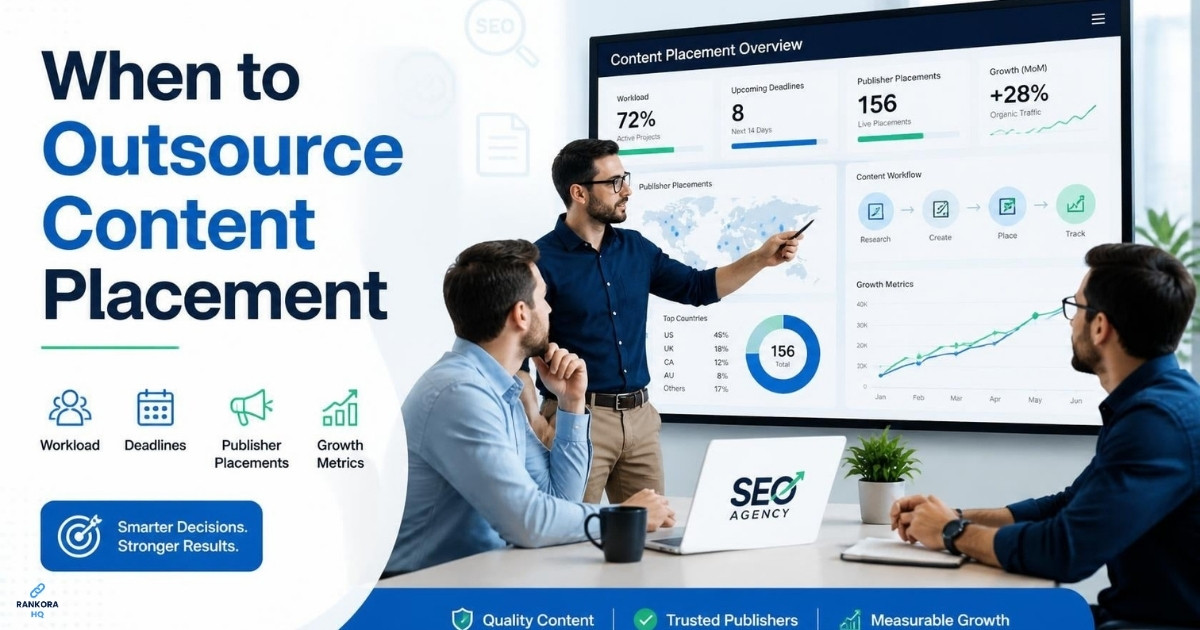
Most SEO agencies do not struggle because they lack clients. They struggle when fulfillment starts taking more time than strategy. That is usually the first sign of when to outsource content placement instead of forcing your internal team to handle every publisher, writer, approval, and report.
In my experience, the right time is not only when your team feels busy. It is when delivery delays, weak publisher access, thin margins, or messy processes start affecting client results. If you are asking when to outsource content placement, the real answer is simple: outsource when content placement outsourcing gives your agency better control, faster delivery, and cleaner margins than doing everything in-house.
What Content Placement Outsourcing Means for SEO Agencies
Content placement outsourcing means handing the execution side of publisher research, outreach, content coordination, placement approval, and reporting to an external fulfillment partner.
For SEO agencies, this is not the same as giving away strategy. The agency still owns the client relationship, campaign direction, target pages, anchor text plan, and final approval. The outsourced partner simply helps deliver the placement work with a cleaner process.
What work usually gets outsourced
The most common outsourced tasks are publisher research, outreach, content writing, editorial coordination, link insertion requests, placement follow-ups, and final reporting.
What should still stay under agency control
The agency should keep control of strategy, client communication, target page selection, approval standards, and campaign goals.
How content placement differs from general content marketing outsourcing
General content marketing outsourcing usually focuses on planning, writing, and publishing content for a brand’s own website or channels.
Content placement outsourcing is different. It focuses on getting content published on relevant third-party editorial sites.
When to Outsource Content Placement

The right time to outsource content placement is when internal delivery starts creating pressure on capacity, quality, margins, or client timelines.
For agencies, this decision should not be emotional. It should be operational. If your team can still deliver strong placements on time, in-house may work. But once fulfillment starts slowing growth, outsourcing becomes a smart way to protect delivery.
Your team cannot deliver placements on time
Missed placement deadlines are one of the clearest signs that your process is stretched.
In my experience, this usually starts small. One publisher takes longer to reply. One article gets delayed. One report goes out late. Then the same issue repeats across several campaigns, and account managers start spending more time explaining delays than showing progress.
Client demand is growing faster than internal capacity
Growth can create delivery problems if your team is not built to handle more placement volume.
An agency may win three or four new SEO clients in a month, but the internal outreach team may still be the same size. That gap creates pressure fast. When agency capacity becomes the bottleneck, content placement outsourcing can help the agency fulfill more work without rushing into new hires.
Outreach work is pulling strategists away from higher-value tasks
SEO strategists should not spend most of their time chasing publisher replies, formatting briefs, or checking placement status.
Those tasks matter, but they are not always the best use of senior time. If your best people are stuck inside fulfillment work, client strategy suffers. This is often the point where agencies should consider a white label partner for execution support.
Placement quality is becoming harder to control
Outsourcing starts to make sense when quality checks become inconsistent.
If one campaign gets strong, relevant placements while another gets weak sites or unclear reporting, the process needs support. Quality should not depend on who had more time that week. A cleaner fulfillment system helps protect standards before clients start noticing gaps.
Capacity Signals That Show Your Agency Is Ready
Capacity issues usually appear before a full delivery breakdown. The problem is not always lack of skill. It is often that the team has more placement work than the current process can handle.
For SEO agencies, these signals matter because content placement is deadline-driven. If one part slows down, the whole campaign feels delayed.
Campaigns depend on one or two overloaded people
If content placement depends on one or two people, the agency has a fragile fulfillment system.
This becomes risky when those people are managing outreach, publisher replies, content briefs, approvals, edits, and reports at the same time. One sick day, one busy week, or one urgent client request can slow everything down.
Publishing slows down near month-end
Month-end delays are a strong sign that placement work is not flowing evenly.
I see this often with agencies that try to push too many placements live at the end of the reporting cycle. The work gets rushed, approvals become tight, and reporting quality drops. That is usually a capacity problem, not just a scheduling issue.
New client wins create fulfillment pressure
Winning new clients should feel like growth, not panic.
If every new SEO client creates stress inside the team, the agency may need outside fulfillment support. This is where content placement outsourcing helps because the agency can grow delivery without hiring too quickly or overloading existing staff.
Account managers spend too much time chasing placement updates
Account managers should not have to keep asking where each placement stands.
When they spend too much time chasing updates, it usually means the process is too manual. A better fulfillment setup should make placement status, approvals, and reports easier to track. Without that, client communication becomes harder than it needs to be.
Capability Signals That Outsourcing Makes Sense
Capability gaps show up when your team has the time to do the work, but not the right access, systems, or experience to do it well.
This is where outsourcing can protect quality. The goal is not just to place more content. The goal is to place content on relevant, trusted publishers without creating extra risk for the client.
Your team lacks reliable publisher relationships
Strong content placement depends on real publisher access.
If your team is starting every campaign from zero, outreach becomes slow and unpredictable. You may spend hours finding sites, sending emails, following up, and still end up with weak options. A white label partner with existing publisher relationships can make delivery more stable.
Niche relevance takes too long to secure
Relevance is often harder than volume.
An agency may find many websites, but not all of them fit the client’s industry, audience, or target page. If your team takes too long to find niche-relevant placements, outsourcing can help reduce research time and improve campaign fit.
Quality checks are inconsistent across campaigns
Content placement quality should not change from one client to another.
If one campaign gets carefully reviewed publishers while another gets rushed checks, the agency has a capability issue. Every placement should be reviewed for relevance, traffic, editorial quality, and link context before approval.
Writers, outreach teams, and publishers are not working in one clear process
Content placement becomes messy when different people work without one shared workflow.
The writer may not understand the publisher’s guidelines. The outreach person may not know the client’s anchor text limits. The publisher may request changes late. When this keeps happening, outsourcing to a structured fulfillment partner can make the process easier to control.
Margin Signals Agencies Should Not Ignore
Margins often reveal the real cost of keeping content placement in-house.
An agency may feel busy and still not be profitable. If the team spends too many hours finding publishers, managing writers, checking sites, and preparing reports, the campaign may look successful on paper but weak in profit.
Internal fulfillment costs are eating project profit
In-house content placement can become expensive fast.
You are not only paying for the final placement. You are paying for research time, outreach tools, writer costs, editing, admin work, follow-ups, and reporting. If those costs keep rising while client retainers stay the same, outsourcing may protect your margin.
Tool, writer, editor, and outreach costs keep rising
Content placement needs more than one person and one tool.
Most agencies need prospecting tools, email tools, writers, editors, outreach staff, and quality checks. When all of those costs sit inside the agency, the true cost per placement can become higher than expected.
Low-margin placements create delivery stress
Low-margin work is dangerous because there is less room for mistakes.
If a placement takes longer than planned, the profit drops. If a writer needs revisions, the profit drops again. If a publisher rejects the content, the team spends more time fixing the issue. These small delays can turn a simple campaign into a margin problem.
Outsourcing becomes useful when cost is predictable
Outsourcing makes sense when it gives the agency a clearer cost structure.
A predictable fulfillment cost helps the agency price retainers, plan delivery, and protect profit. It also makes scaling easier because the agency knows what each placement should cost before accepting more client work.
Process Limits That Make In-House Placement Risky
Process problems make content placement harder to control, even when the team is skilled.
This usually happens when too much of the work lives in inboxes, spreadsheets, and memory. If the agency cannot clearly track what is approved, pending, published, or reported, in-house fulfillment becomes risky.
There is no clear approval workflow
Every placement needs a clear approval path.
The agency should know who approves publishers, topics, anchor text, drafts, and final URLs. If approvals happen through scattered messages, mistakes become more likely. A weak approval process can lead to the wrong site, wrong anchor, or wrong client expectation.
Reporting takes longer than the placement work
Reporting should not become a second campaign.
If your team spends hours collecting live links, screenshots, metrics, publisher details, and notes, the process is too heavy. This is a sign that fulfillment is not organized well enough to scale.
Publisher vetting depends on manual checks
Manual vetting works at low volume, but it becomes harder as campaigns grow.
When every site has to be checked from scratch, the team can miss important details. Traffic quality, niche fit, content standards, and link context all need review. Without a repeatable vetting system, placement quality becomes inconsistent.
Client communication becomes reactive instead of planned
Reactive communication is a warning sign.
If clients only hear from the agency when there is a delay, rejection, or issue, trust starts to weaken. A stronger process gives the agency clear updates before the client has to ask. That is often when outsourcing can help bring structure back into delivery.
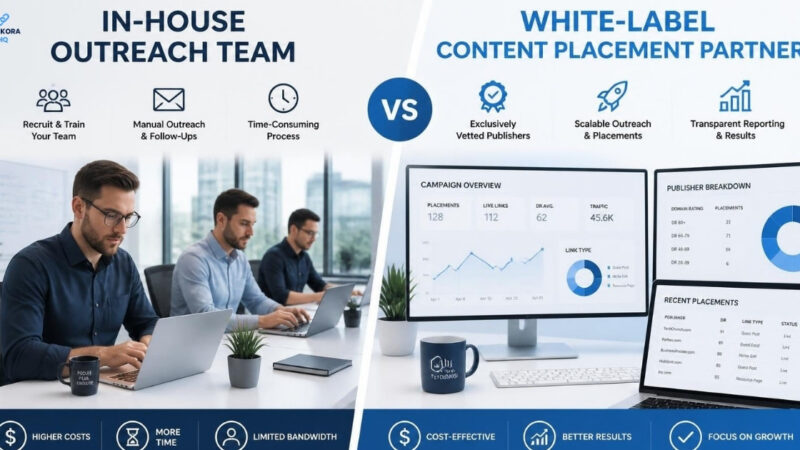
When Agencies Should Keep Content Placement In-House
Outsourcing is not always the right move. Some agencies should keep content placement in-house if their volume, margins, and publisher access are already under control.
The decision should come down to pressure. If your team can deliver quality placements on time without hurting strategy, client service, or profit, there may be no need to outsource yet.
Placement volume is still low and manageable
If your agency only needs a small number of placements each month, in-house delivery may still make sense.
Low volume is easier to manage with a small team. The work may not justify bringing in a fulfillment partner if your team can handle research, outreach, approvals, and reporting without delays.
The team already has strong publisher access
Strong publisher relationships are a real advantage.
If your team already has reliable access to relevant editorial sites, outsourcing may not add much value.
The agency wants direct control over every relationship
Some agencies prefer to manage every publisher conversation themselves.
This can make sense for high-touch clients, sensitive niches, or campaigns where relationships matter more than speed.
A Simple Decision Framework Before You Outsource
The easiest way to decide is to check whether outsourcing gives your agency more control, not less.
I usually look at four areas first: delivery capacity, internal expertise, profit margin, and client risk. If two or more are under pressure, outsourcing is worth considering.
Check delivery capacity
Start with your current workload.
Ask how many placements your team can deliver each month without delays, rushed checks, or weak reporting. If the answer changes every month, your capacity is not stable enough to scale safely.
Check internal expertise
Next, look at what your team does well.
If your team is strong at SEO strategy but weak at publisher outreach, it may not make sense to keep forcing outreach in-house. Outsource the execution gap while keeping strategy under your control.
Check profit margins
Then review the real cost of each placement.
Include writer time, editor time, outreach time, tools, revisions, reporting, and management. If the internal cost is too close to what the client pays, outsourcing may help protect your margin.
Check client risk
Client risk matters more than placement volume.
If delays, weak publisher options, or unclear reports could damage the client relationship, the agency needs a better system. Outsourcing can make sense before the problem becomes visible to the client.
Decide what to outsource first
You do not need to outsource everything at once.
Start with the part causing the most pressure. That may be publisher research, outreach, content writing, link insertions, reporting, or full content placement fulfillment. A focused start is easier to control than a rushed handover.
Frequently Asked Questions
When should an SEO agency outsource content placement?
An SEO agency should outsource content placement when internal delivery starts affecting timelines, quality, margins, or client communication.
Is content placement outsourcing the same as link building outsourcing?
Not exactly. Content placement outsourcing focuses on securing editorial placements, managing content, approvals, publishing, and reporting.
Should small SEO agencies outsource SEO fulfillment?
Yes, if fulfillment work is slowing growth or taking time away from strategy, sales, and client management.
How do I know if in-house content placement is no longer working?
It is no longer working when campaigns get delayed, publisher quality drops, reporting becomes messy, or your team feels overloaded every month.
Can outsourcing content placement protect agency margins?
Yes. A predictable fulfillment cost can help agencies price retainers better and avoid hidden internal costs.
What should an agency prepare before outsourcing?
Prepare target pages, anchor text guidance, niche requirements, quality standards, content instructions, and approval rules before handing off work.
Conclusion
Content placement should help an SEO agency grow, not slow it down. If your team can deliver quality placements on time, keep strong margins, and manage client updates clearly, in-house work may still make sense.
But when delays, weak publisher access, rising costs, or messy reporting start affecting delivery, outsourcing becomes a smart decision. The goal is not to give up control. The goal is to protect strategy, improve fulfillment, and give clients a better experience.
If your agency is reaching that point, Rankora HQ can help with white-label editorial content placement that keeps your brand in front and your process under control.
Author Bio
Author: Muhammad Awais
Title: Founder, Rankora HQ
Muhammad Awais is the founder of Rankora HQ, a white-label editorial content placement service based in Salalah, Oman. He helps SEO agencies and brands build topical authority through high-quality publishing partnerships on DR 40-90 editorial sites.
LinkedIn: linkedin.com/in/muhammad-awais-seo-outreach