
White label content placement pricing is rarely based on one fixed cost. It usually combines publisher fees, content creation, outreach, coordination, approvals, and campaign management. In my experience, agencies understand pricing much better when they separate these cost layers instead of looking only at the final placement fee.
The right white label content placement pricing model also depends on how the campaign is structured. Some agencies prefer paying per placement, while others work with bundles, retainers, or custom pricing. In this guide, I’ll explain how white label content placement pricing works, what affects the final cost, and how agencies can build sensible reseller margins without turning pricing into guesswork.
How White Label Content Placement Pricing Is Built
White-label placement pricing usually comes from several separate costs working together. The final amount is not just a publisher fee. It can also include writing, outreach, coordination, approvals, reporting, and account management.
For agencies, understanding these cost layers makes reseller pricing easier. It also helps explain why two placements with similar metrics can still have different total costs.
Publisher Fees and Site Placement Costs
Publisher fees are often the largest direct cost. This is the amount charged for publishing content on a specific website.
The fee can change based on the publisher, niche, traffic quality, editorial standards, and placement requirements. Some sites also charge differently depending on content type or linking conditions.
Content Creation and Editorial Costs
If writing is included, content creation becomes another part of the total price. This may cover research, drafting, editing, formatting, and revisions.
More technical or specialist topics usually require more work. Agencies should separate writing costs from placement costs when reviewing a quote.
Outreach, Communication, and Campaign Management
A placement also requires coordination behind the scenes. Someone has to contact publishers, confirm availability, discuss requirements, manage revisions, and track approvals.
These tasks may not appear as a separate line item, but they still affect overall content placement costs.
Approval, Reporting, and White-Label Delivery Costs
White-label campaigns often include client approvals, placement tracking, reporting, and branded delivery.
In my experience, this part matters more as campaign volume grows. A provider is not only securing the placement. They are also managing the process so the agency can deliver it smoothly under its own brand.
Why Content Placement Costs Vary Between Campaigns
Content placement costs can change significantly from one campaign to another. The main reason is that every publisher, niche, and campaign comes with different requirements.
A higher price does not always mean a better placement. Agencies need to understand what is driving the cost before comparing offers.
Publisher Authority, Traffic, and Editorial Standards
Publishers with stronger traffic, established authority, and stricter editorial standards often charge higher fees.
The quality of the site matters more than a single metric. Real traffic, niche relevance, editorial control, and content quality can all influence publisher fees.
Niche Difficulty and Publisher Availability
Some niches have fewer suitable publishers available. This can increase placement costs because the number of relevant opportunities is limited.
https://rankorahq.com//guest-posting-service/Industries with stricter editorial policies or higher commercial value may also require more outreach before a suitable placement is secured.
Content Requirements and Editorial Complexity
Simple articles generally require less production work than technical, research-heavy, or highly regulated topics.
Extra research, specialist knowledge, multiple revisions, or strict publisher guidelines can increase the content creation cost attached to a placement.
Turnaround Time and Special Campaign Requirements
Urgent campaigns can require faster outreach, writing, approvals, and publisher coordination.
Special requirements such as specific traffic levels, niche restrictions, anchor rules, or publication deadlines can also narrow the available publisher pool and affect pricing.
Placement Volume and Ongoing Commitments
Campaign size can influence the overall pricing structure. A one-off placement is managed differently from a campaign involving multiple placements every month.
Larger or recurring campaigns may allow providers to plan outreach and publisher relationships more efficiently, while smaller custom campaigns often require more work per placement.
The Main Content Placement Pricing Models
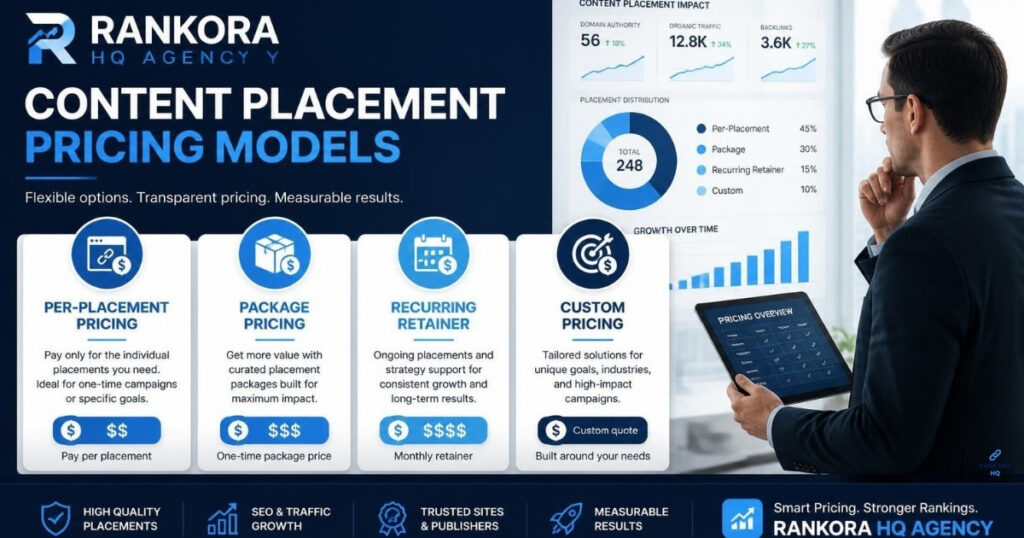
Agencies usually encounter four main placement pricing models. Each one handles cost, volume, and campaign flexibility differently.
The best model depends on whether the agency needs one placement, multiple placements, ongoing delivery, or a highly specific campaign.
Per-Placement Pricing
Per-placement pricing charges a fixed amount for each approved placement.
This model is simple and easy to track. It works well when an agency needs occasional placements or wants clear costs for individual client campaigns.
Package and Bundle Pricing
Bundle pricing combines several placements into one package.
This approach can make budgeting easier for agencies managing multiple links or publishers at the same time. The package may also include writing, reporting, or other supporting services.
Recurring or Monthly Retainer Pricing
Retainer pricing is designed for ongoing campaigns with regular monthly placement needs.
Instead of buying placements one by one, the agency pays for a recurring level of delivery. This model can provide more predictable planning for both costs and campaign volume.
Custom Campaign Pricing
Custom pricing is used when a campaign does not fit a standard package.
The final price may depend on niche difficulty, publisher quality, content requirements, turnaround time, approval steps, or campaign complexity. This model gives agencies more flexibility when client requirements are highly specific.
How Agency Markup Works in White-Label Placement
Agency markup is the amount added on top of the provider’s base cost before the service is sold to the end client.
The goal is not simply to increase the price. The markup should cover the agency’s own work, risk, communication, and profit.
Provider Cost vs Client-Facing Price
The provider cost is what the agency pays for the placement and any included services.
The client-facing price is what the agency charges its customer after adding its own costs and margin. These two figures should be treated separately when planning reseller pricing.
Markup vs Profit Margin
Markup and profit margin are not the same thing.
Markup is calculated from the original cost, while margin is based on the final selling price. Mixing the two can make an agency think a campaign is more profitable than it really is.
What Agency Markup Needs to Cover
Agency markup may need to cover account management, client communication, revisions, reporting, billing, and internal overhead.
It should also leave room for unexpected work. A placement that requires extra coordination can reduce profit quickly if the agency only marks up the publisher fee.
Building Reseller Pricing Without Losing Margin
A practical reseller pricing model starts with the full campaign cost, not just the placement charge.
Agencies should include provider fees, internal servicing costs, and a reasonable profit target before setting the final client price. This creates a clearer and more sustainable pricing structure.
Choosing the Right Pricing Model for Each Client
The right pricing model depends on campaign size, client expectations, and how predictable the placement work will be.
Agencies should choose the model that makes costs easy to manage without creating unnecessary risk or complexity.
When Per-Placement Pricing Makes Sense
Per-placement pricing works well for one-off campaigns, smaller clients, or projects with irregular demand.
It gives the agency a clear cost for each placement and makes individual campaign budgeting easier.
When Bundled Pricing Works Better
Bundle pricing is useful when a client needs several placements within a defined campaign.
It can simplify quoting and reduce the need to price every placement separately. Agencies should still make sure the package scope is clearly defined.
When a Monthly Model Is More Practical
A recurring pricing model fits clients that need consistent placements every month.
It can make campaign planning more predictable and help agencies manage ongoing delivery, reporting, and client expectations.
When Custom Pricing Is Necessary
Custom pricing is better when a campaign has unusual requirements.
This may include difficult niches, specific publisher standards, complex content, strict deadlines, or a limited pool of suitable sites.
Comparing the Models by Flexibility, Predictability, and Risk
Per-placement pricing offers flexibility, while retainers provide more predictable monthly planning. Bundles sit somewhere between the two.
Custom pricing gives the most control for complex campaigns, but it also requires more careful cost calculation before the agency quotes the client.
What to Check Before Comparing Placement Quotes
Two placement quotes can look similar while covering very different levels of service. Agencies should compare what is included, not just the final number.
A clear quote should make it easy to understand where the content placement costs come from and what happens during delivery.
What Is Actually Included in the Quoted Price?
Start by checking whether the quote covers only the publisher fee or the complete placement process.
Outreach, writing, editing, approvals, reporting, and account management may be included or charged separately.
Is Content Writing Included or Charged Separately?
Some providers include article creation in the placement price. Others treat writing as a separate service.
Agencies should confirm this before calculating their own reseller pricing, especially when multiple articles are required.
What Type of Publishers Are Included?
Publisher quality can have a major effect on pricing.
Look beyond basic authority metrics. Relevant traffic, editorial quality, niche fit, and genuine readership give better context when comparing placements.
Are Publisher Fees Fixed or Variable?
Publisher fees are not always the same across every site or campaign.
Some placements may have stable rates, while others depend on the publisher, niche, content requirements, or current availability.
What Happens if a Placement Is Rejected or Removed?
Agencies should understand the provider’s process if a publisher rejects the content or a placement later becomes unavailable.
Replacement terms, revision requirements, and approval conditions can affect the true cost and risk of a campaign.
Are Approval and Reporting Included?
White-label delivery often involves more than publishing an article.
Confirm whether the agency can approve publishers before publication and whether final reporting is included. These steps can add real value to the overall placement process.
Common Pricing Mistakes Agencies Should Avoid
Pricing problems often happen when agencies focus on the visible placement fee and ignore the full delivery cost.
A better approach is to price each campaign around its real workload, risk, and client requirements.
Choosing Placements Based Only on the Lowest Price
The cheapest placement is not always the best value.
Low pricing can sometimes reflect weaker publisher quality, limited traffic, poor niche relevance, or fewer service inclusions.
Treating Publisher Fees as the Total Campaign Cost
Publisher fees are only one part of the total expense.
Writing, outreach, revisions, account management, approvals, and reporting can all add to the real cost of delivery.
Ignoring Internal Account Management Costs
Agencies also spend time managing clients, reviewing placements, handling revisions, and preparing reports.
If that internal work is not included in pricing, profit margins can shrink quickly.
Applying the Same Markup to Every Campaign
A fixed markup does not suit every project.
Simple campaigns may require little management, while complex niches or demanding clients can involve much more work and risk.
Selling Packages Before Confirming Scope and Costs
Packages should be built around clear deliverables and known cost assumptions.
Quoting too early can create problems if publisher fees, content needs, or approval requirements are higher than expected.
Frequently Asked Questions
What Does White-Label Content Placement Usually Include?
It can include publisher sourcing, outreach, content coordination, approvals, publication, and reporting.
The exact scope varies by provider, so agencies should confirm what is included before comparing prices.
Why Do Publisher Fees Vary So Much?
Publisher fees can change based on niche, traffic, editorial standards, authority, and availability.
Two sites with similar metrics may still charge very different rates because their audiences and publishing requirements are different.
Is Content Writing Normally Included in Placement Pricing?
Sometimes it is included, and sometimes it is priced separately.
Agencies should confirm whether research, writing, editing, and revisions are part of the quoted placement cost.
How Do Agencies Mark Up White-Label Content Placements?
Agencies usually add a markup above their total delivery cost.
That markup may cover account management, client communication, internal overhead, risk, and profit.
Is Per-Placement or Monthly Pricing Better for Agencies?
Per-placement pricing gives more flexibility for irregular campaigns.
Monthly pricing can work better when clients need consistent placement volume and predictable ongoing delivery.
Why Are Some Niches More Expensive to Place Content In?
Some industries have fewer relevant publishers or stricter editorial requirements.
That can increase outreach effort, publisher fees, and the overall cost of securing a suitable placement.
How Should Agencies Compare Two Content Placement Quotes?
Compare the full scope rather than only the final price.
Check publisher quality, writing, approvals, reporting, replacement terms, management, and any extra fees before deciding which quote offers better value.
Conclusion
White label content placement pricing works best when agencies understand what sits behind the final quote. Publisher fees, content creation, outreach, campaign management, and internal servicing costs can all affect the real cost of a placement.
The right pricing model depends on the client, campaign volume, niche, and delivery requirements. Whether you use per-placement, bundle, retainer, or custom pricing, the goal should be clear costs, realistic margins, and a structure that can scale without creating unnecessary risk.
Author Bio
Muhammad Awais is the founder of Rankora HQ, a white-label editorial content placement service based in Salalah, Oman. He helps SEO agencies and brands build topical authority through high-quality publishing partnerships on DR 40–90 editorial sites.