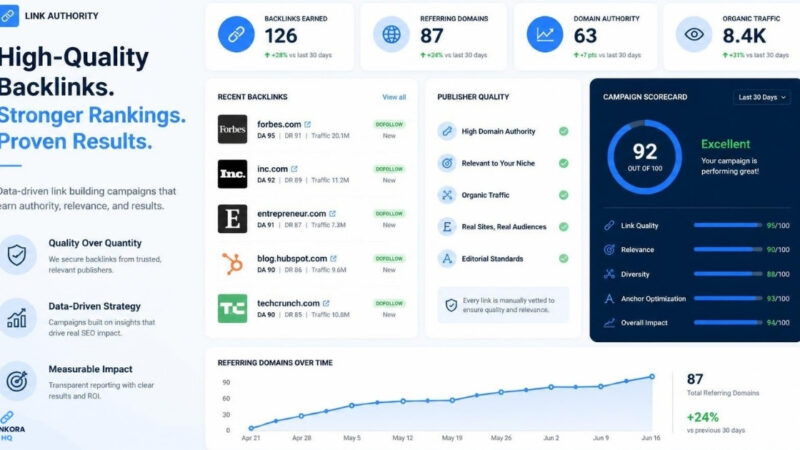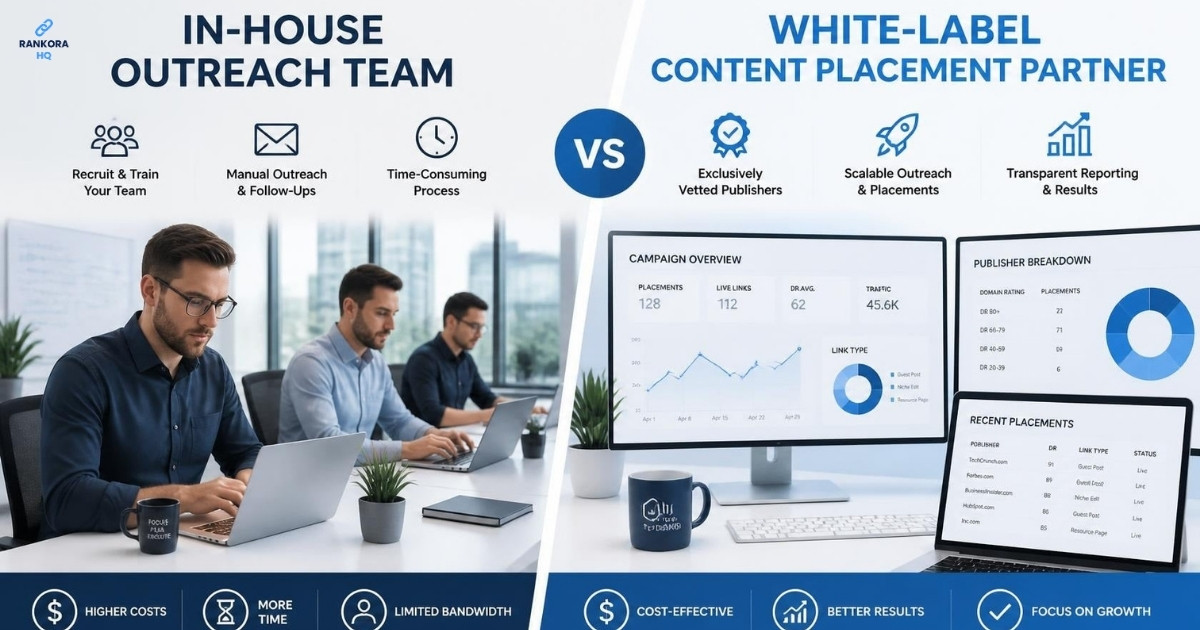
Choosing between white label content placement vs in house outreach is really a decision about how your agency wants to manage people, systems, cost, and delivery pressure. In my experience running Rankora HQ, most agencies do not struggle because they lack clients. They struggle because outreach fulfillment becomes harder to control as client demand grows.
This guide compares white label content placement vs in house outreach from an agency operations point of view. We will look at staffing, tools, publisher access, cost structure, speed, quality control, scalability, and management workload. By the end, you should know whether white label content placement vs in house outreach makes more sense for your current agency model.
White label content placement vs in house outreach: the direct comparison
White label content placement vs in house outreach comes down to one main question: do you want to build the outreach operation yourself, or use an external fulfillment system that already exists?
An in-house outreach team gives your agency direct control over hiring, publisher research, prospecting, negotiation, content coordination, and reporting. But that control comes with more management, more tools, and more fixed costs.
White-label content placement gives you a fulfillment layer behind your agency. You still manage the client relationship, approve placements, and protect your brand. The partner handles the heavy outreach work in the background.
What each model means for an SEO agency
An in-house outreach team means your agency owns the full content placement process. You hire the people, train them, build the systems, manage inboxes, check publisher quality, and deal with delays.
This model can work well when you have steady placement volume every month. It also helps if outreach is a core part of your agency’s long-term positioning.
An outsourced content placement model means you use a white-label partner to execute the placement work. Your agency stays client-facing, while the partner supports research, outreach, content coordination, publishing, and reporting.
This works well when you want capacity without building a full internal department.
Quick comparison table: staffing, cost, speed, control, and scale
| Area | In-house outreach team | White-label content placement |
| Staffing | Requires hiring and training | No internal outreach hires needed |
| Cost | Fixed monthly payroll and tools | More flexible, project-based cost |
| Speed | Slower to build at first | Faster to start fulfillment |
| Control | High direct control | Approval-based control |
| Capacity | Limited by team size | Easier to scale with demand |
| Management | Heavy internal workload | Lower daily management load |
| Quality responsibility | Fully on your agency | Shared, but agency still approves |
The simple agency fulfillment comparison is this: in-house gives more direct control, while white-label gives more operational flexibility.
Neither model is automatically better. The better choice depends on your client volume, margins, team capacity, and how much fulfillment pressure you want to carry internally.
Staffing requirements are the first major difference

Staffing is usually the first real difference between an in-house outreach team and outsourced content placement. One model requires you to build a team. The other gives you access to fulfillment support without adding new employees.
This matters because outreach is not one simple task. It needs research, prospecting, email management, content coordination, negotiation, quality checks, and reporting.
What an in-house outreach team needs
An in-house outreach team needs more than one person sending emails. At minimum, you need someone to find publishers, manage outreach, check site quality, coordinate content, and report results.
As the workload grows, one person quickly becomes a bottleneck. They may handle small campaigns, but larger client accounts need more structure.
You also need training. Outreach staff must understand relevance, DR, traffic quality, anchor text, publisher guidelines, and client expectations.
What a white-label content placement partner replaces
A white-label partner replaces much of the internal staffing burden. Instead of hiring outreach staff, your agency uses an existing fulfillment process.
The partner can handle publisher research, outreach, placement coordination, content publishing, and white-label reporting. Your agency still reviews and approves the work before it reaches the client.
This setup helps agencies avoid payroll pressure while still delivering content placements under their own brand.
Why hiring outreach talent is harder than it looks
Hiring outreach talent sounds simple until you see the daily work involved. Good outreach people need patience, judgment, organization, and strong communication skills.
Systems, tools, and publisher access decide execution quality
Systems, tools, and publisher access often decide whether outreach runs smoothly or becomes messy. Even a skilled in-house outreach team needs the right setup to manage campaigns at scale.
Content placement is not only about finding websites. It also includes prospect tracking, inbox management, quality checks, content briefs, approvals, follow-ups, and final reporting.
The tools an in-house outreach team must manage
An in-house team usually needs several tools to run outreach properly. These may include email accounts, prospecting tools, SEO metrics tools, spreadsheets, project management software, and reporting templates.
Each tool adds cost and setup time. Someone also needs to keep the data clean and make sure no prospect, approval, or placement gets missed.
Without a clear system, outreach becomes scattered. Emails get lost. Follow-ups become inconsistent. Quality checks happen too late.
Why publisher relationships take time to build
Publisher access is one of the hardest parts of in-house outreach. Good placements come from trust, repeated communication, and knowing which publishers are worth using.
How outsourced content placement reduces setup work
Content placement outsourcing reduces setup work because the fulfillment system is already active. The partner already has outreach processes, publisher checks, approval workflows, and reporting structure.
Your agency does not need to build everything from zero. You can send requirements, review options, approve placements, and receive the final report.
This is why many agencies use white-label support when they want faster execution without creating a full internal outreach department.
Control is higher in-house, but workload is heavier
Control is one of the biggest reasons agencies consider building an in-house outreach team. When everything happens inside your agency, you can manage the process directly from start to finish.
But more control also means more responsibility. Your team must manage every publisher conversation, every approval, every delay, and every quality issue.
Where in-house outreach gives more direct control
In-house outreach gives you full control over prospect lists, outreach messages, publisher selection, content briefs, anchor text use, and client reporting.
This can be useful if your agency has very strict processes or serves clients with sensitive brand requirements.
You can also train your team to follow your exact standards. That level of control is harder to build when the work is handled outside your agency.
Where white-label content placement still allows approval control
White-label content placement does not mean giving up all control. A good white-label process still lets your agency approve publishers before anything goes live.
At Rankora HQ, this approval step matters because agencies need to protect their client relationships. Nothing should be published until the agency is comfortable with the site, topic, anchor, and content direction.
This gives agencies a lighter form of control. They do not manage every outreach task, but they still control the final decision.
The difference between control and responsibility
Control and responsibility are not the same thing. In-house outreach gives you more control, but it also puts every problem on your team.
If a publisher stops replying, your team must chase them. If content needs revision, your team must manage it. If reporting is delayed, your team must fix it.
With outsourced content placement, the daily workload shifts to the partner. Your agency still reviews the work, but it does not have to manage every moving part.
That is the trade-off. In-house gives deeper control. White-label gives controlled approval with less operational pressure.
Cost structure: fixed payroll vs flexible fulfillment
Cost structure is one of the clearest differences between in-house outreach and white-label content placement. An internal team creates fixed costs. A white-label partner usually turns fulfillment into a more flexible project cost.
This matters for agencies because client demand is not always steady. Some months may need 5 placements. Other months may need 50.
In-house outreach costs beyond salaries
An in-house outreach team costs more than monthly salaries. You also need tools, email accounts, training, management time, content support, and quality review.
There are also hidden costs. If the team has low campaign volume, you still pay them. If the team is overloaded, delivery slows down.
That makes outreach costs harder to control when client demand changes quickly.
White-label content placement as a variable cost model
White-label content placement works more like a variable fulfillment cost. You pay based on the work needed instead of carrying a full internal team every month.
This can help agencies protect margins. It also makes it easier to quote clients because the fulfillment cost is clearer from the start.
For many agencies, this is the main benefit of content placement outsourcing. They can grow delivery without adding payroll too early.
When fixed costs become risky for agencies
Fixed costs become risky when an agency does not have enough steady placement volume. A full-time outreach team needs consistent work to justify the expense.
If client campaigns slow down, the agency still carries the same payroll and tool costs. If campaigns increase suddenly, the team may not have enough capacity.
That is why the cost decision should match your agency’s volume. In-house works better when demand is stable. White-label support works better when you need flexibility without long-term staffing pressure.
Speed and capacity change as client demand grows
Speed and capacity become harder to manage when client demand increases. An in-house outreach team can work well at a steady pace, but it can struggle when several clients need placements at the same time.
White-label content placement gives agencies more flexibility because the fulfillment support is not limited to one internal hire or one small team.
Why in-house teams hit capacity limits
In-house outreach teams hit limits because each campaign needs manual work. Someone must find publishers, send emails, follow up, check quality, coordinate content, and prepare reports.
When volume grows, these small tasks stack up fast. A team that handles 10 placements comfortably may struggle when the number becomes 30 or 40.
This can lead to slower replies, missed follow-ups, weaker publisher checks, and delayed client updates.
How content placement outsourcing supports faster fulfillment
Content placement outsourcing can support faster fulfillment because the process is already built. The partner already has outreach workflows, publisher access, content coordination, and reporting systems in place.
This does not mean every placement happens instantly. Good editorial placements still need review, approval, writing, and publishing time.
But agencies can usually start faster because they are not hiring, training, or building systems from scratch.
Quality control belongs somewhere in both models
Quality control does not disappear in either model. The only difference is where most of the responsibility sits.
With an in-house outreach team, your agency owns every quality check. With white-label content placement, the partner handles much of the process, but your agency still needs final approval before anything goes live.
What quality control looks like in-house
In-house quality control means your team checks every publisher, topic, anchor text, content draft, and live placement.
This gives you direct oversight. But it also adds more work to your team’s daily schedule.
Someone must check if the publisher is relevant, has real traffic, accepts proper editorial content, and matches the client’s expectations. If your team skips this step, weak placements can damage trust fast.
What the agency must still review when outsourcing
Outsourcing does not mean you stop reviewing quality. Your agency should still approve the publisher, topic direction, anchor text, and final placement details.
At Rankora HQ, I believe approval is what keeps white-label work safe for agencies. The client sees your brand, so your agency should always know what is being published before it goes live.
This keeps the process transparent without forcing your team to manage every outreach task.
Why approval workflows protect client trust
Approval workflows protect the client relationship. They make sure nobody publishes on the wrong site, uses the wrong anchor, or sends content live before the agency is ready.
This matters in both models. In-house teams need internal approval steps. White-label partners need clear agency approval steps.
Good quality control is not about doing everything yourself. It is about knowing who checks what, when approval happens, and who is responsible if something needs to be fixed.
Which model fits your agency right now?
The right model depends on your agency’s current workload, margins, and management capacity. An in-house outreach team works best when content placement is a core part of your agency and demand is steady.
White-label content placement works best when you need reliable fulfillment without hiring, training, and managing a full outreach team.
When an in-house outreach team makes more sense
An in-house outreach team makes sense when your agency has consistent monthly placement volume and enough margin to support salaries, tools, and management time.
It can also work well if your agency wants full control over every publisher relationship and outreach conversation.
This model is better for agencies that see outreach as a long-term internal department, not just a service they need to fulfill.
When white-label content placement makes more sense
White-label content placement makes more sense when your agency needs delivery capacity without adding fixed costs.
It is also useful when client demand changes from month to month. You can scale fulfillment up or down without carrying a larger team all year.
In my experience, this model helps agencies stay focused on strategy, sales, and client communication while the outreach work is handled behind the scenes.
Frequently Asked Questions
Is white-label content placement cheaper than in-house outreach?
White-label content placement is often cheaper for agencies that do not have steady monthly volume. In-house outreach can cost more because of salaries, tools, training, and management time.
Do agencies lose control when they outsource content placement?
Agencies do not lose control if the process includes approval steps. Your agency should still approve publishers, topics, anchors, and placement details before anything goes live.
Can an in-house outreach team scale faster than a white-label partner?
Usually, no. An in-house team needs hiring, training, and systems before it can scale. A white-label partner can often support extra volume faster because the process is already built.
Who is responsible for content quality in each model?
With in-house outreach, your agency owns the full quality-control process. With white-label content placement, the partner supports quality checks, but your agency should still review and approve the final work.
Should a small SEO agency hire outreach staff or outsource first?
Most small agencies should outsource first if client demand is still uneven. Hiring makes more sense when placement volume is stable enough to support payroll and tools.
Conclusion
Choosing between white-label content placement and in-house outreach is not about which model sounds better. It is about which one fits your agency’s current stage.
If you have steady placement volume, strong margins, and the patience to build a team, in-house outreach can give you deeper control. But if you need flexible fulfillment, faster capacity, and less management pressure, white-label content placement is often the cleaner option.
If your agency needs transparent editorial placements without building a full outreach department, Rankora HQ can support your fulfillment behind the scenes.
Author Bio
Author: Muhammad Awais
Title: Founder, Rankora HQ
Muhammad Awais is the founder of Rankora HQ, a white-label editorial content placement service based in Salalah, Oman. He helps SEO agencies and brands build topical authority through high-quality publishing partnerships on DR 40-90 editorial sites.